What After-Hours Garage Door Repair Actually Costs in London
It is almost always the same phone call. A bang loud enough to wake the street, then a door that will not lift — or worse, one that will not come down, with the whole garage standing open to a February night. Nobody plans for this, and at 11 p.m. there is no time to research it properly. So here is the short course: which failures genuinely warrant an after-hours call, what happens once you dial, what the invoice should look like, and what you can safely do in the meantime.

Treat a garage door as an emergency when it leaves the house open, pins a vehicle you need, or has become unsafe to touch — in practice that means a snapped torsion spring, a parted lift cable, a door off its track, or a dead opener on a door you cannot secure. Garage Door London runs a 24/7 board and reaches most London addresses in 60–120 minutes, finishing the large majority of calls on the first visit. Plan on $180–$550 all in for a typical after-hours repair, agreed as a flat number before anyone picks up a tool. Call (226) 781-1003.
What types of emergency garage door repairs are available in London, Ontario?
After-hours work is a deliberately short list. It is not the night for a tune-up, a quote on a new door, or a dented panel that offends you every morning. The job at 1 a.m. is narrower than that: make the house secure, make the door safe, and get you moving again. Practically every call we take falls into one of seven buckets.
| Repair | What you notice | Typical on-site time | Same-visit fix? |
|---|---|---|---|
| Broken torsion / extension spring | A bang, then a door far too heavy to lift | 60 – 90 min | Usually yes |
| Snapped or frayed lift cable | One corner sags; slack cable off the drum | 45 – 90 min | Usually yes |
| Door off its track | Door wedged at an angle, roller outside the rail | 60 – 120 min | Usually yes |
| Opener failure | Motor hums, or nothing happens at all | 45 – 90 min | Often yes |
| Safety sensor fault | Door starts down, then reverses; light blinking | 30 – 45 min | Yes |
| Impact damage to a panel | Bent section after a bumper meets the door | Secure now, replace later | Secure only |
| Door stuck fully open | House standing open, door will not travel | 30 – 60 min | Secure, then repair |
Broken spring repair
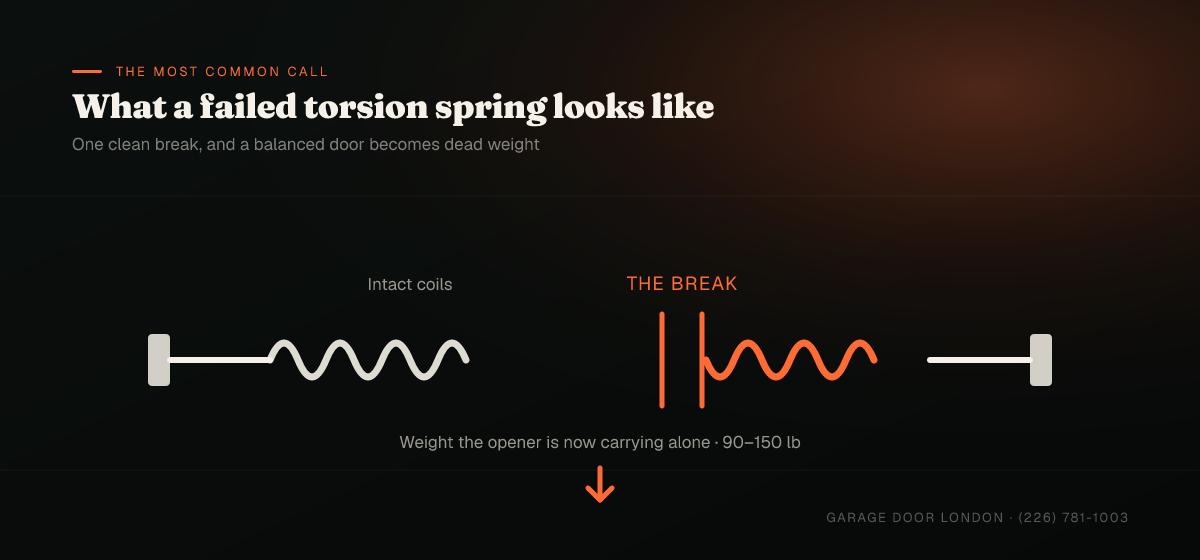
This is the one we are called out for more than everything else combined, and the one homeowners consistently misread. People assume the opener lifts the door. It does not — the torsion spring does essentially all of that work, and the opener just tells it when to go. Take the spring away and a well-behaved double door becomes 90 to 150 lb of steel with nothing holding it up. A chain drive asked to do that job on its own will groan, slip, or simply stop.
Springs are rated in cycles, one cycle being a single open and close, and a builder-grade unit is typically good for about 10,000 of them. Steel also gets brittle as it gets cold, which is why our call volume climbs every January and February in London: the metal has been flexing through freeze and thaw all winter and eventually finds its weakest coil. Replacement is a one-visit job in nearly every case — clamp the door, wind out whatever tension remains, fit the new spring (in matched pairs where the door carries two), re-tension, then re-balance by hand. The full walkthrough lives in our broken spring replacement guide, and the service page is spring repair.
Cable replacement
The lift cables run from a bracket at the bottom of the door up to a drum beside the spring, and their job is to keep the descent even. They give out slowly rather than suddenly: moisture works into the strands, a drum sits slightly out of true, or the door spends months running out of balance and quietly grinds them down. A frayed cable is urgent precisely because the failure is one-sided — when it lets go under load, one corner drops while the other stays put. Cables get replaced in pairs and never spliced, whatever the internet suggests. See cable repair.
Garage door opener emergencies
Openers fail in three recognisable ways: stone dead, intermittent, or running happily while the door ignores it. The overnight job is working out which part is actually at fault — remote, wall control, logic board, drive gear, or the photo-eyes — and then either re-pairing the remotes, realigning the sensors, or swapping a stripped gear kit or capacitor. Where the board has failed on a unit already past fifteen, replacement beats repair on cost within a year or two; our opener replacement guide lays out that maths. Service page: opener repair.
Off-track doors and securing an opening
A roller leaving its rail sounds minor and is not. The door loses the geometry that keeps its weight distributed, and from that point it can drop. Getting it back means bleeding off the tension safely, seating the rollers, fixing whatever caused it — nine times in ten a cable or a seized roller — and then re-balancing the whole assembly; see track repair. Where a vehicle has folded a section beyond an overnight fix, the night's work is simply to close and secure the opening properly, with panel replacement booked once the matching section arrives.
How does 24-hour emergency garage door repair operate in London?
Round-the-clock service only works when the process behind it is dull and repeatable. There is no clever trick to it — just a sequence that has been run enough times to have the surprises taken out.
- 1. The call, and honest triage. Describe the behaviour, not the verdict. A bang followed by a heavy door is a spring. A door hanging crooked is a cable. A door that starts down and changes its mind is the sensors. That distinction determines what gets loaded on the truck, which in turn decides whether this is one visit or two.
- 2. A window you can plan around. You get a realistic arrival time before the call ends — usually 60 to 120 minutes across London, depending on hour, weather and where you are. Byron, Masonville, Oakridge and White Oaks tend to sit at the quick end; St. Thomas, Woodstock and Strathroy run longer, and we say so rather than promising otherwise.
- 3. Safety first, then a full look. The technician makes the door safe before diagnosing anything, then checks springs, cables, drums, rollers, track, hinges, opener and sensors together. Garage door failures cascade: a parted cable that also chewed a roller and tweaked a track section is one job, not three call-backs a fortnight apart.
- 4. A number, agreed in advance. One flat price covering parts, labour and any after-hours premium, approved before a tool comes out. No meter running, no discovering the total on the invoice.
- 5. Repair, then proof it is safe. Balance test, force and travel limits, auto-reverse against an obstruction, photo-eye function — all checked before anyone leaves. A door that moves is not the same as a door that is safe.
- 6. Honest handling of what cannot be finished. If a part is genuinely not stocked — an obsolete board, a specific panel profile — the opening gets secured that night and the finish work is booked the moment it lands.
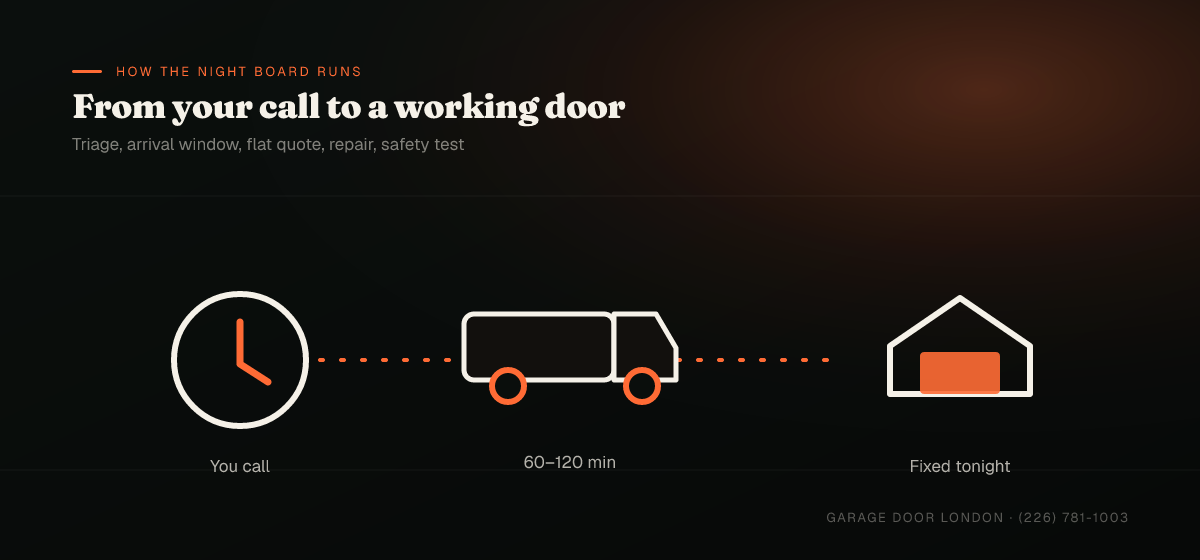
The thing that separates a genuine 24/7 operation from an answering service is not who picks up the phone. It is whether springs, cables, rollers and common opener parts are already on the van at midnight. That is what turns most calls into a repair rather than an appointment to come back.
| Detail | Why it matters |
|---|---|
| Your neighbourhood or postal code | Sets a realistic arrival window |
| What you heard or saw when it failed | Separates spring, cable and opener faults |
| Whether a vehicle is trapped inside | Raises priority in the queue |
| Door type — single, double, insulated | Determines spring size and door weight |
| Opener brand and rough age | Tells us which parts to load |
| Whether the door is stuck open | Security risk; dispatched first |
How much does emergency garage door repair cost in London, Ontario?
Every emergency invoice is built from the same four pieces: getting someone there, the part itself, the labour to fit it, and a premium if the clock says it is nobody's working hours. Understanding the pieces is the whole defence against being quoted a number you have no way to sanity-check at midnight.
| Component | Typical range | What it covers |
|---|---|---|
| Service call / diagnostic | $95 – $150 | Travel, full inspection, written diagnosis |
| Parts | $60 – $300 | Springs, cables, rollers, gear kits, boards |
| Labour | $100 – $200 | Tension work, re-railing, balancing, testing |
| After-hours premium | +$80 – $150 | Evenings, overnight, weekends, holidays |
Put together, here is what London homeowners actually end up paying for a complete after-hours repair:
What moves the number
- What actually broke. Realigning a photo-eye is half an hour with no parts. A spring set on a heavy insulated double is tension work, two components, and a full re-balance afterwards.
- The hour on the clock. Overnight, weekend and statutory-holiday calls carry a premium because somebody is on call rather than on shift. That is a real cost and a fair one — what is not fair is finding out about it afterwards.
- How heavy the door is. Insulated and double-wide doors need higher-cycle springs and heavier-gauge cable. They cost more up front and last considerably longer, which usually makes them the cheaper choice over a decade.
- Whether the part is on the van. Springs, cables, rollers and common gear kits get fixed that night. Obsolete boards and specific panel profiles have to be ordered, which splits the work into secure-now and finish-later.
- How long it was left. A door run for weeks on a dying spring usually needs rollers and a length of track as well. Catching it early is comfortably the cheapest repair available.
- Where you are. Central London carries no travel surcharge; St. Thomas, Woodstock, Strathroy, Ingersoll and Dorchester add travel time to the window.
Insisting on a straight price
Emergency work attracts opportunistic pricing for an obvious reason: you are under pressure, it is late, and comparison shopping is not realistic. Three habits close that gap completely and cost you nothing.
- Get the total before the work starts. Itemized — parts, labour, after-hours premium, tax — and agreed. A cheerful “let's see what it needs” is how a $300 job becomes a $700 one.
- Ask what happens if the diagnosis changes. A straight operator stops, re-quotes and asks again. A poor one keeps working and adds lines.
- Have a published range to check against. Our repair cost guide and spring repair cost guide list current London pricing, which is worth something at 11 p.m. when nothing else is open.
If a quote you have been handed sits well outside these ranges, phone us for a second opinion. We would genuinely rather tell you the price is fair than watch someone overpay in a panic. You can also request a written quote online at any hour.
Common garage door emergencies and how to identify them early
Here is the part nobody wants to hear at midnight: the overwhelming majority of emergencies we attend had been announcing themselves for weeks. Doors are not subtle. They get louder, slower and less even long before they fail outright — the signals just get absorbed into the background of a busy household.
- A new noise. Grinding, screeching, or the same pop at the same point in the travel every time. Something — a bearing, a roller, a spring coil — is on its way out.
- Movement that is no longer even. A door that sags at one corner, jerks, or shudders on the way up is telling you a cable or spring has drifted out of balance.
- A door that has got slow. Sluggishness almost always means a weakening spring, with the opener quietly absorbing work it was never built to do.
- Visible wear, if you look. A gap in a torsion coil, rust weeping at a cable, broken strands near the bottom bracket, a roller standing proud of its track.
- Sensors behaving oddly. A door that reverses partway down for no apparent reason, or an opener light blinking a count at you, has an alignment or wiring fault.
- A failed balance test. Disconnect the opener, raise the door to waist height, let go. A healthy door stays exactly where you left it. One that sinks or climbs has a spring problem — book it now, on your schedule, at daytime rates.
The test is not complicated: if the door leaves your home exposed, traps a vehicle you need, or could hurt somebody, it is an emergency. Everything else is a booking at ordinary rates. And if you genuinely cannot tell, ring and describe it — we will say plainly whether it can wait until morning rather than sell you a premium you do not need. Our companion piece on the signs you need emergency garage door repair works through the same judgement in more depth, while what to do when your door fails covers the first five minutes.
Can emergency repairs be done overnight, or only same day?
Yes — though not everything should be, and a technician worth calling will tell you which is which. Overnight work exists to remove danger and close a security gap. A few jobs are simply better done in daylight, and pretending otherwise costs you money.
Worth doing at 2 a.m.
- Closing an open house. A door stuck open leaves the garage, its contents and often an unlocked interior door exposed. Even when the full repair has to wait for a part, the opening gets shut and secured that night.
- Springs and cables. Stock parts, well-rehearsed work, and the thing standing between you and a functioning door. Routinely completed after dark.
- Anything actively unsafe. A door that will not reverse on an obstruction, or one hanging on a failed cable, is a hazard to whoever wanders in first. That gets dealt with on arrival.
- Freeing a trapped vehicle. A car you need for work, a hospital run, or an early flight is reason enough on its own.
Better left for the morning
- Panels and sections. They are colour- and profile-matched and usually ordered in. Overnight we secure the opening; the section goes in later.
- Full opener replacement. Unless the existing unit is dangerous, a daytime swap gives you room to pick the right drive rather than whatever is on the van — see belt vs chain drive.
- A whole new door. Measuring, colour selection and crew scheduling all want daylight. Start at new door installation.
- Comfort work. Weather seals, insulation upgrades and repainting have never been emergencies and never will be.
Our emergency garage door service covers London and the surrounding communities — Byron, Masonville, White Oaks, Westmount, Hyde Park, Oakridge, Lambeth and Wortley Village among them — so no corner of the city spends a weekend with a door that will not shut.
Why choose a professional emergency garage door repair service
Most household repairs are a reasonable argument between doing it yourself and paying someone. Garage door springs are not one of them. A residential torsion spring holds several hundred pounds of stored force, and the standard way it goes wrong is a winding bar slipping under load in a confined space. Ontario emergency departments see the results every year, and they are not near-misses.
- The symptom is rarely the fault. A door that will not close might be a sensor, a limit setting, a bent track or a cable off its drum. Guessing costs more than diagnosing, in parts and in time.
- Springs have to be matched, not just replaced. Wire gauge, inside diameter, length and cycle rating are all specified against the door's actual weight. An undersized spring works beautifully for a month, then takes the opener with it.
- Repetition makes it quick. Work that costs a homeowner a nervous weekend is 60 to 90 minutes for someone who does it daily — including the safety tests most DIY repairs never get around to.
- A warranty means a second visit is our problem. Parts and labour both covered, which is the practical difference between a door that is fixed and a door that has gone quiet for a while.
- Fully insured. Garage Door London carries full insurance, so damage during a repair is covered rather than argued about.
How to judge who you are calling
| Standard | What good looks like | Red flag |
|---|---|---|
| Availability | A real person answers 24/7, gives an arrival window | Voicemail, vague “sometime tonight” |
| Pricing | Flat, itemized quote approved before work | “We'll see what it needs” |
| Parts | Springs, cables, rollers stocked on the truck | Second trip for routine parts |
| Warranty | Written warranty on parts and labour | No paperwork offered |
| Credentials | Licence and insurance stated openly | Evasive when asked |
| Safety testing | Balance, force limits, auto-reverse tested | Door works, no tests run |
| Reviews | Detailed, recent, owner replies to criticism | Only five-word five-star reviews |
Reading reviews properly
A star average on its own tells you very little. What actually predicts a decent experience is the texture underneath it: reviews that name the specific repair and the neighbourhood, feedback spread across months rather than arriving in one suspicious burst, and above all how the business answers its critics. A company that replies substantively to a two-star review is a company that will answer the phone when you call back. Ours are on the customer reviews page.
How to prepare for an emergency repair and stay safe while you wait
The hour before the van arrives is the one part of this you control, and it matters more than people expect — both for your safety and for how quickly the job goes. None of it involves touching anything under tension.
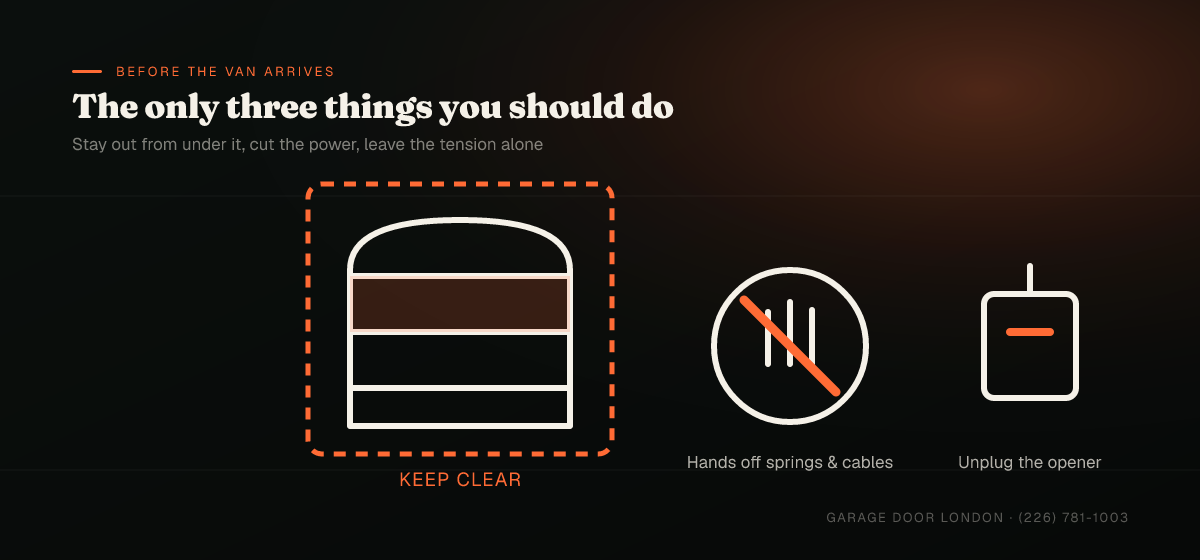
- 1. Stop pressing the button. Every attempt against a jammed or unbalanced door bends more track and cooks the opener motor a little further. This is how one failure becomes three.
- 2. Pull the plug on the opener. Cutting power removes any chance of the door being activated while someone is standing near it — a remote in a coat pocket, a child who knows where the wall button is.
- 3. Clear people, pets and cars. A door under partial tension can move without warning. Nobody stands under it, nobody parks under it, nobody reaches into the track.
- 4. Leave the springs, cables and bottom bracket entirely alone. They hold their energy whether the door is moving or not. Look from a distance, note what you see, touch nothing.
- 5. Only pull the red cord if the door is fully down. Releasing a raised door that is sitting on a broken spring lets it fall. If the door is open and unbalanced, wait. This single step is the most common route from an expensive problem to an injury.
- 6. Open up a working path. Move bikes, bins and boxes a good metre clear of both vertical tracks. Ladder space is needed on each side, plus a clear run to the opener.
- 7. Write down what happened. The noise, when it started, what the door did afterwards, and any blink code on the opener light. Blink codes in particular are a straight shortcut to the fault.
- 8. Put the lights on. Garage lighting and an outside light make an overnight repair faster and safer for everybody.
- 9. Secure the house if the door is stuck open. Lock the interior door between garage and house, move anything valuable out of sight, and keep somebody home until help arrives.
A residential torsion spring can hold several hundred pounds of force, and winding bars slip without warning. With the spring gone, the door is 90–150 lb with nothing beneath it. Once you total up a bent track and a burnt-out opener, calling a trained technician is not only the safe option — it is usually the cheap one too.
Once you are clear of the door, call (226) 781-1003 or contact us online. Tell us the neighbourhood, what the door is doing, and whether a car is stuck inside, and you will get a realistic arrival window.
How smart garage door technology is changing emergency repair
Connected openers and retrofit controllers — myQ, Aladdin Connect, and the Matter-compatible units now shipping on new hardware — have changed emergency work in two quiet, practical ways. They catch problems earlier than a household would, and they shorten diagnosis once somebody is standing in the garage.
| Feature | What it does | Why it matters at 2 a.m. |
|---|---|---|
| Open/close status alerts | Phone notification when the door is left open | You learn the door is stuck open before a thief does |
| Remote close | Shut the door from the app | Confirms whether the fault is mechanical or the remote |
| Cycle counting | Logs how many times the door has run | Predicts spring end-of-life before it snaps |
| Fault and blink codes | Opener reports a specific error | Cuts diagnosis time and part guesswork |
| Integrated camera | Live view of the door and bay | Shows whether the door is off track before dispatch |
| Motion and obstruction logs | Records reversals and blockages | Pinpoints an intermittent sensor fault |
| Battery backup | Runs the opener through a power cut | Turns a Sunday storm outage into a non-event |
Two honest caveats. Smart features are not safety features: what actually stops a door on a child or a pet is a correctly aligned photo-eye and a properly set auto-reverse, and both still need testing once a year by somebody who knows what they are looking at. And an app that reports “door open” cannot tell you why — if the door is heavy, crooked or noisy, the answer is mechanical and it is still under the hood.
Where this technology genuinely earns its keep is prevention. A cycle counter turns spring replacement from a 2 a.m. emergency into a booked appointment on a Tuesday. Battery backup removes power cuts from the emergency list altogether, which is worth more than it sounds in a city that reliably loses power to summer storms and winter ice. If your opener predates all of this, a retrofit controller is cheap; a full replacement makes sense once the unit is fifteen or older. And if the power is already out tonight, our guide to opening a garage door manually will get you moving safely.
The most effective prevention, though, remains thoroughly unglamorous: an annual tune-up that lubricates the rollers, checks the cables for broken strands, tests the balance and tightens the hardware. Our winter maintenance checklist is written specifically around London's freeze-thaw cycle, and it heads off the clear majority of the calls we take after midnight.
Get a flat-rate price in minutes
Frequently asked questions
Yes. Garage Door London dispatches technicians 24 hours a day, seven days a week across London, Ontario and surrounding communities, including evenings, weekends and holidays. Call (226) 781-1003 and you will get a real arrival window before you hang up.
Typical arrival is 60 to 120 minutes depending on the time of day, weather, and your location. Central London neighbourhoods such as Byron, Masonville, Oakridge, White Oaks and Hyde Park are usually at the fast end of that range; outlying communities such as St. Thomas, Woodstock and Strathroy can take longer.
Most after-hours repairs land between $180 and $550 all-in. That breaks down as the flat $95 service call, credited to your repair, plus $60 to $300 in parts and $100 to $200 in labour. The only premium is $60 for dispatches between midnight and 6 AM — evenings, weekends and holidays are charged at the standard rate. You approve a flat, itemized price before any work begins.
After-hours calls carry a modest premium, typically $80 to $150, because a technician is on call rather than on schedule. The parts and labour rates themselves do not change. If your door is safe and secured, booking a normal daytime appointment will cost less.
Any failure that leaves your home unsecured, traps a vehicle you need, or makes the door unsafe to operate. That includes a door stuck fully open, a snapped torsion spring, a broken or frayed cable, a door off its track, and panel damage after a vehicle strike. Noisy operation, a dead remote, or a worn weather seal can wait for a scheduled visit.
Yes. Spring replacement, cable replacement, re-railing an off-track door, and securing a door stuck open are all routinely completed overnight because the parts are carried on the truck. Panel replacement, full opener replacement and new door installation are normally scheduled for daylight hours after the opening has been secured.
Stop pressing the opener, unplug it, and keep people and vehicles clear of the doorway. Do not try to force the door down by hand if it feels heavy or moves unevenly. Lock the interior door between the garage and the house, and call for emergency service — a door stuck open is a security risk and is prioritised in the dispatch queue.
No. A residential torsion spring stores several hundred pounds of force and winding bars can slip under load without warning. With the spring gone the door itself weighs 90 to 150 pounds with nothing holding it. Spring and cable work is the one category of garage door repair that should always be done by a trained, insured technician.
Your neighbourhood or postal code, what you heard or saw when the door failed, whether a vehicle is trapped inside, the door type (single, double, insulated), the opener brand and rough age, and whether the door is stuck open. Accurate details mean the technician arrives with the right parts on the truck.
It helps in two ways. Alerts tell you the door has been left open or has failed before you would otherwise notice, and fault or blink codes plus cycle counts speed up diagnosis on site. Smart features do not replace mechanical safety, though — photo-eye sensors and a correctly set auto-reverse still need annual testing.
Yes. Emergency work carries a written warranty on both parts and labour, the same as a scheduled repair. Garage Door London is fully insured, and every repair ends with a balance test, force and travel limit check, and an auto-reverse safety test.
What we put in writing
A fixed price before we start. The full price in writing after the diagnosis and before any work begins. Find something unexpected once the door is open and we stop and re-quote rather than adding it to your bill.
A written warranty. Lifetime on the parts we supply and five years on our labour, printed on the invoice rather than promised at the door.
A safety test before we leave. Balance, cables, drums, opener force and travel limits, and the auto-reverse tested against an obstruction — recorded on your invoice with the date.