Garage Door Roller, Hinge, Bearing and Drum Replacement in London, Ontario
Springs and openers get all the attention, but the parts that actually decide how a garage door sounds — and how long the springs and opener last — are four unglamorous bits of hardware costing a few dollars each. Rollers, hinges, bearings and cable drums. Here is what each does, what it sounds like when it fails, and what replacing it costs in London.

Rollers are the wheels that ride the track; a full set of sealed nylon rollers costs $150 to $300 installed and is the single best noise fix on any garage door. Hinges join the sections and are numbered by position — $90 to $200 for a set. End and centre bearings carry the torsion shaft and cause a low rumble when dry — $120 to $260. Cable drums wind the lift cables and cause the door to hang crooked when a set screw slips — $150 to $320. All four are routine repairs, and all four are cheaper than what they damage when ignored.
Garage door rollers: the cheapest upgrade you can make
A sectional door has ten to thirteen rollers, two or three per section, and every one of them carries part of the door’s weight along the track. When they wear, the door gets loud, it starts to shudder, and the rollers begin scrubbing against the track instead of rolling — which drags on the opener and pulls the door out of square.
The grade of roller makes an enormous difference, and it is the one part where paying more is unambiguously correct.
| Roller type | Bearings | Noise | Service life | Set of 10, installed |
|---|---|---|---|---|
| Builder-grade steel | None or 7 ball | Loud, metallic | 2 – 4 years | $110 – $180 |
| Basic plastic | None | Quiet at first, then squeals | 2 – 3 years | $100 – $160 |
| Sealed nylon, 13 ball bearing | 13 sealed ball | Near silent | 8 – 12 years | $150 – $300 |
| Heavy-duty steel, 13 ball | 13 ball | Moderate | 10 – 15 years | $180 – $340 |
| Commercial nylon / high-cycle | 13+ sealed | Quiet under load | 10 – 15 years | Quoted per door |
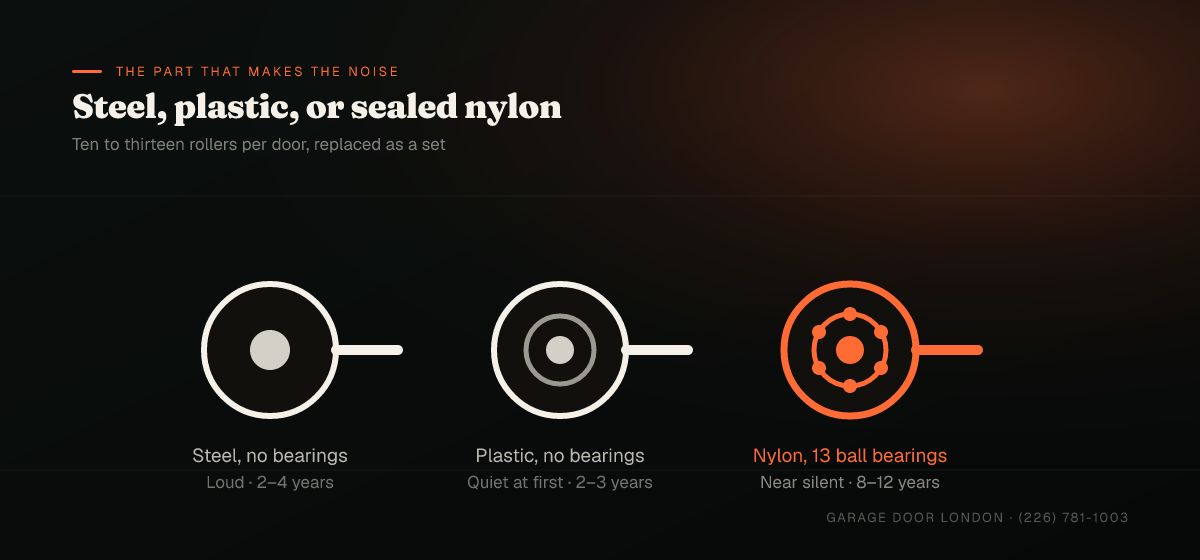
Most doors in London leave the factory on builder-grade steel rollers with no bearings at all, because they cost the builder about two dollars each. Upgrading a set to sealed nylon is usually the single most satisfying repair a homeowner books: the door goes from waking the house at 6 a.m. to genuinely quiet, and the opener stops working as hard. If you are chasing noise specifically, read it alongside our noisy garage door guide.
What worn rollers look like
- Flat spots or chips on the wheel — you will hear a rhythmic thump once per revolution
- The wheel does not spin freely when you turn it by hand with the door closed
- Visible wobble in the track as the door travels
- Black dust or fine metal shavings along the bottom of the vertical track
- The wheel sitting off-centre in the track, or rubbing one side
One safety note. The top and middle rollers are a straightforward swap for a competent DIYer with the door closed. The bottom rollers are not — they sit in the bottom brackets, which are under the full tension of the lift cables. Removing a bottom bracket with the springs loaded is one of the most dangerous things you can do in a garage. Leave those to a technician; our track and roller service covers it.
Garage door hinges: numbered for a reason
Hinges join the sections together and hold the roller stems. Look closely at one and you will see a stamped number — 1, 2, 3 and so on. That number is not decorative: it sets how far the roller stem is offset from the door face, which is what lets each section pivot correctly as the door curves from vertical to horizontal.
| Hinge number | Where it goes | What it does |
|---|---|---|
| No. 1 | Between the bottom and second section, at the ends | Zero offset — keeps the lowest joint tight to the track |
| No. 2 | Between the second and third section | Slight offset as the door begins to curve |
| No. 3 | Between the third and fourth section | Greater offset for the upper curve |
| No. 4+ | Upper joints on tall or four-plus section doors | Progressive offset toward the top |
| Centre hinges | Mid-span on every joint | Carry load between the end hinges; no roller stem |
| End hinges | Both ends of every joint | Hold the roller stems |
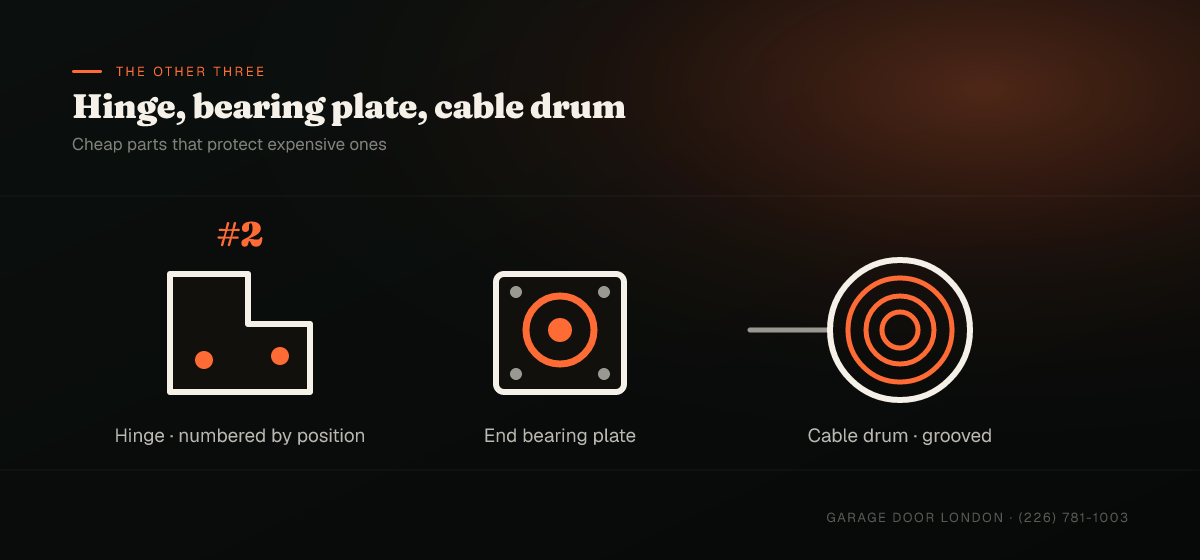
Fitting the wrong number in the wrong position is a common DIY error and it shows immediately: the door binds in the curve, the rollers scrub, and the section joints take load they were not designed for. If a hinge has been replaced and the door started rubbing afterwards, that is almost always why.
Signs a hinge needs replacing
Look for elongated bolt holes — a teardrop shape where a round hole should be — visible cracks around the roller stem sleeve, rust that has eaten into the metal, or a gap opening at a section joint as the door travels. Cracked hinges are especially common on doors that have been run out of balance for years, because the joint has been taking load the springs should have been carrying. A full set of hinges runs $90 to $200 installed, and it is usually worth doing at the same time as rollers since the technician is already working through every joint.
End bearings, centre bearings and what a rumble means
On a torsion-sprung door, the whole spring assembly turns on a steel shaft, and that shaft rides in bearings: one at each end in the bearing plates, and usually one in the centre bracket where the springs meet. They are small, they cost very little, and when they dry out or wear they announce themselves clearly.
The sound is distinctive — a low, grinding rumble that rises and falls with the door’s travel, coming from above the opening rather than from the track. It is quite different from the metallic clatter of worn rollers or the squeal of dry hinges. If you can hear a rumble and the door still runs smoothly, you have caught it early.
| Sound | Where from | Likely part | Typical fix |
|---|---|---|---|
| Rhythmic thump, once per revolution | Along the track | Flat-spotted roller | Roller set replacement |
| Metallic clatter and rattle | Whole door | Worn steel rollers, loose fasteners | Rollers, tighten hardware |
| Dry squeal on every cycle | Section joints | Dry hinges | Lubricate, replace if cracked |
| Low grinding rumble | Above the opening | End or centre bearing | Bearing replacement |
| Sharp bang, then a heavy door | Above the opening | Broken torsion spring | Emergency spring replacement |
| Popping or snapping in the curve | Upper track | Binding hinge or wrong hinge number | Hinge replacement |
| Scraping on one side only | One vertical track | Track out of alignment, or a slipped drum | Track and drum service |
Bearing replacement runs $120 to $260 depending on how many and whether the springs have to come off to do it. It is not a DIY job on a torsion door: reaching a bearing plate means unloading the spring, which needs winding bars and the right technique. On an older door it is often sensible to replace bearings at the same time as springs, since the labour overlaps almost completely — ask for it as a combined price when you book spring repair.
If the torsion shaft visibly moves up and down or side to side as the door runs, the bearing has failed rather than merely worn. A shaft flexing under spring load puts the drums, cables and the spring itself out of alignment, and the usual next event is a cable jumping its drum. Stop using the door and book a repair.
Cable drums: the part that makes a door hang crooked
The cable drums sit at each end of the torsion shaft and are grooved so the lift cables wind on evenly. Both drums are locked to the shaft by set screws, and because both sides are on the same shaft, the two cables are forced to wind and unwind together. That is the mechanism that keeps a torsion door square.
When a drum slips — a loose set screw, a worn keyway, or a groove that has been chewed by a frayed cable — one side of the door starts travelling further than the other. The symptoms are unmistakable:
- The door sits visibly higher on one side when closed, with daylight on one corner
- One lift cable is slack while the other is taut
- A cable has come off its drum entirely and is looped in the corner
- The door binds or scrapes on one vertical track only
- A loud clunk from one end of the shaft as the door starts to move
Drum replacement runs $150 to $320, usually done in pairs and almost always with new cables at the same time — a drum that has damaged one will have damaged the other. Because the cables have to be re-wound and re-tensioned to bring the door back to square, this is spring-tension work and belongs with a technician. Our cable and drum repair page covers the service, and the cable repair guide goes deeper on the cable side.
If the door has already come off its track as a result, do not try to lever it back — the geometry that holds the weight is gone and the door can drop. Read garage door off track and call for emergency service.
What to replace first, and what it costs
If you are looking at an aging door and wondering where the money is best spent, this is the order that gives the most back.
Rollers first, every time. They are the loudest, the fastest-wearing, and the ones whose failure drags most on everything else. A sealed nylon set transforms how a door sounds and takes measurable load off the opener.
Hinges second, and ideally in the same visit — the technician is already working joint by joint, so the incremental labour is small.
Bearings and drums when symptoms appear, or bundled with spring replacement when that day comes. Both live above the opening and both need the springs unloaded to reach, so pairing them with spring work saves an hour of labour.
Is a full hardware refresh worth it?
On a door under about fifteen years old with sound sections, yes — roughly $470 buys you a door that runs quietly and squarely for another decade, against $1,890 and up for a replacement door. On a door over twenty with rusted or delaminating sections, the money is better put toward a new door; our repair or replace guide works through that decision, and new garage door cost in London has the numbers.
Garage Door London carries rollers, hinges, bearings and drums on the truck, so hardware work is usually a single visit. We cover London and the surrounding communities including Oakridge, Lambeth and Wortley Village — request a quote or see all our services.
Get a flat-rate price in minutes
Frequently asked questions
A full set of ten sealed nylon rollers costs $150 to $300 installed. Builder-grade steel rollers are $110 to $180 but last only two to four years. Heavy-duty steel rollers with 13 ball bearings run $180 to $340 and last 10 to 15 years.
Yes, on almost any door. Sealed nylon rollers with 13 ball bearings run near silently and last 8 to 12 years against 2 to 4 for the builder-grade steel rollers most doors ship with. They also reduce drag on the opener, which extends its life.
Look for flat spots or chips on the wheels, rollers that do not spin freely when turned by hand, visible wobble in the track, black dust or metal shavings along the bottom of the vertical track, and a rhythmic thump once per wheel revolution as the door travels.
The top and middle rollers, yes, with the door closed and the opener unplugged. The bottom rollers, no. They sit in the bottom brackets, which carry the full tension of the lift cables, and removing a loaded bottom bracket is one of the most dangerous things you can do in a garage.
The number sets how far the roller stem is offset from the door face, which lets each section pivot correctly as the door curves from vertical to horizontal. No. 1 hinges go at the lowest joint with zero offset, and the offset increases going up. Fitting the wrong number causes the door to bind and the rollers to scrub.
Usually a worn or dry end bearing or centre bearing carrying the torsion shaft. The sound rises and falls with the door's travel and comes from above the opening rather than from the track. Replacement is $120 to $260 and is not a DIY job, since the springs must be unloaded to reach the bearing plates.
Most often a cable drum has slipped on the torsion shaft — a loose set screw, a worn keyway, or a groove damaged by a frayed cable. One cable then winds further than the other and the door goes out of square. Drums are replaced in pairs, usually with new cables, for $150 to $320.
Fifteen to twenty-five years on a well-maintained door. They fail early on doors that have been running out of balance, because the section joints take load the springs should be carrying. Watch for elongated bolt holes, cracks around the roller stem sleeve, and gaps opening at a joint as the door travels.
Usually yes. The technician works joint by joint for either job, so doing both together costs about $320 rather than roughly $370 done separately, and it puts the whole door on fresh hardware at once.
On a door under about fifteen years old with sound sections, a refresh at roughly $470 buys another decade of quiet, square operation against $1,890 and up for a new door. On a door over twenty with rusted or delaminating sections, put the money toward replacement instead.
What we put in writing
A fixed price before we start. The full price in writing after the diagnosis and before any work begins. Find something unexpected once the door is open and we stop and re-quote rather than adding it to your bill.
A written warranty. Lifetime on the parts we supply and five years on our labour, printed on the invoice rather than promised at the door.
A safety test before we leave. Balance, cables, drums, opener force and travel limits, and the auto-reverse tested against an obstruction — recorded on your invoice with the date.