Custom Garage Door Installation in London, Ontario: Sizes, Styles and Real Costs
Most London garages take a stock door off the shelf, and for most houses that is the right answer. But older openings in Old North and Wortley Village were rarely built to today's dimensions, and plenty of homeowners want something a catalogue simply does not carry. That is where custom comes in — and where the price, the lead time and the measuring all change.
A custom garage door in London, Ontario costs $3,200 to $9,500 installed, against $1,890 to $3,800 for a stock door. Custom means one of three things: a non-standard size for an opening that does not match the 8, 9, 16 or 18-foot stock widths; a custom style such as carriage house, full-view glass or real wood; or a custom colour or finish outside the manufacturer's standard range. Lead times run 4 to 12 weeks — measure and order early, because nothing about a custom door is quick.
What actually makes a garage door “custom”?
The word gets used loosely, and it covers three genuinely different things — each with its own cost implication. It is worth knowing which one applies to you, because a custom colour is a modest premium while a custom size in real wood is a different category of spend entirely.
| Type of customisation | What it means | Typical premium over stock | Lead time |
|---|---|---|---|
| Non-standard size | Opening does not match 8, 9, 16 or 18 ft stock widths | +15% – 40% | 4 – 8 weeks |
| Custom style | Carriage house, full-view glass, contemporary flush | +40% – 150% | 5 – 10 weeks |
| Custom colour or finish | Outside the standard palette; factory paint or woodgrain | +10% – 30% | 4 – 8 weeks |
| Custom glazing | Obscure, tinted, tempered or insulated glass units | +15% – 45% | 5 – 10 weeks |
| Real wood construction | Cedar, mahogany, hemlock overlay or solid | +120% – 300% | 8 – 12 weeks |
| Custom hardware and track | Low-headroom, high-lift, vertical-lift conversions | +$400 – $1,600 | 3 – 6 weeks |
The most common trigger in London is the least glamorous: the opening simply is not a stock size. Houses built before roughly 1970 — and there are a great many of them in Old North, Blackfriars and Wortley Village — were built for narrower cars and to no particular standard. A 7′6″ or 8′4″ opening is not unusual, and neither is one that is 40 mm wider at the top than at the bottom.
You have two routes when that happens: order a door made to the opening, or reframe the opening to take a stock door. Reframing is sometimes cheaper, but only where the header and the structure above it allow it — and on a masonry opening it rarely does. We will tell you honestly which is the better spend once we have measured.
Custom garage door styles, and what each one is really like to own
Style is where the money goes on most custom projects, and where the trade-offs are least obvious from a brochure photograph.
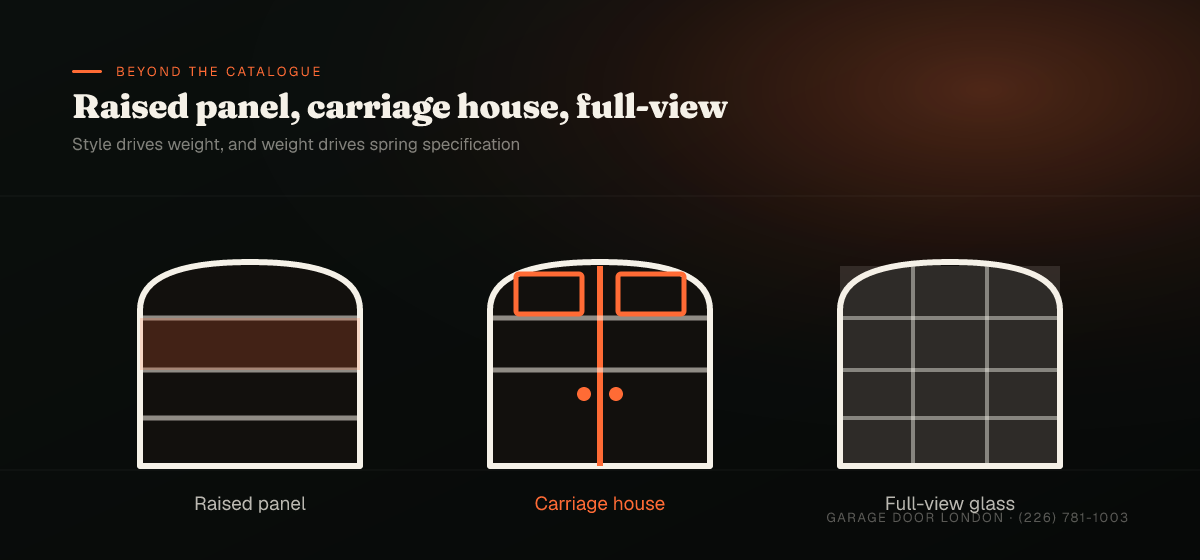
Carriage house
Swing-style appearance on a modern sectional door: overlay boards, decorative strap hinges and handles, usually with a row of windows. Overwhelmingly the most requested custom look in London, and it suits the city’s older brick housing stock genuinely well. Practical notes: the overlay adds real weight, which means a heavier spring specification and often a stronger opener; and composite overlays hold up far better than real wood through freeze-thaw. Budget $3,800 to $7,200 installed.
Full-view glass and aluminium
Anodised or powder-coated aluminium stiles with glass in every section. Striking on a contemporary build, and increasingly common on garages used as workshops or gyms because of the daylight. The honest trade-offs: insulation value is poor unless you specify insulated glazing units, privacy needs obscure or frosted glass, and the door is heavy. In a London winter an uninsulated full-view door on an attached garage will be felt in the house. Budget $4,500 to $9,500 installed.
Contemporary flush and grooved
Smooth or long-panel steel with no raised detail, often in a dark factory colour or a woodgrain wrap. Cheaper than carriage house or full-view, ages well, and pairs cleanly with modern builds in Masonville and the newer subdivisions. Budget $3,200 to $5,600 installed.
Real wood
Cedar, mahogany or hemlock, either solid or as an overlay on a steel or composite core. Unquestionably the best-looking option and the most demanding one: it needs refinishing every three to five years in this climate, it is heavy, and it moves with humidity. Beautiful on the right house, and worth going in with clear eyes about maintenance. Budget $6,500 to $14,000+ installed.
Whichever way you lean, our how to choose a garage door guide covers material and insulation decisions in more depth, and garage doors and curb appeal is worth reading if resale value is part of the calculation.
Measuring for a custom garage door
This is the part that goes wrong most often, and a custom door is not returnable. Six measurements matter, and the first rule is: measure the opening, never the old door. The existing door may have been wrong all along.
| Measurement | What it is | Why it matters |
|---|---|---|
| Rough opening width | Finished masonry or framing, edge to edge | Sets the door width; measure at top, middle and bottom |
| Rough opening height | Floor to the underside of the header | Sets the door height; measure both sides |
| Headroom | Header to ceiling or the nearest obstruction | 12″ standard torsion; 4″ possible with low-headroom track |
| Sideroom | Opening edge to the nearest wall or obstruction | 3.75″ minimum per side for standard track |
| Backroom | Opening to the back wall | Door height plus 18″ for a standard operator |
| Floor level | Difference across the opening | A sloped floor means a custom bottom section or a wedge seal |
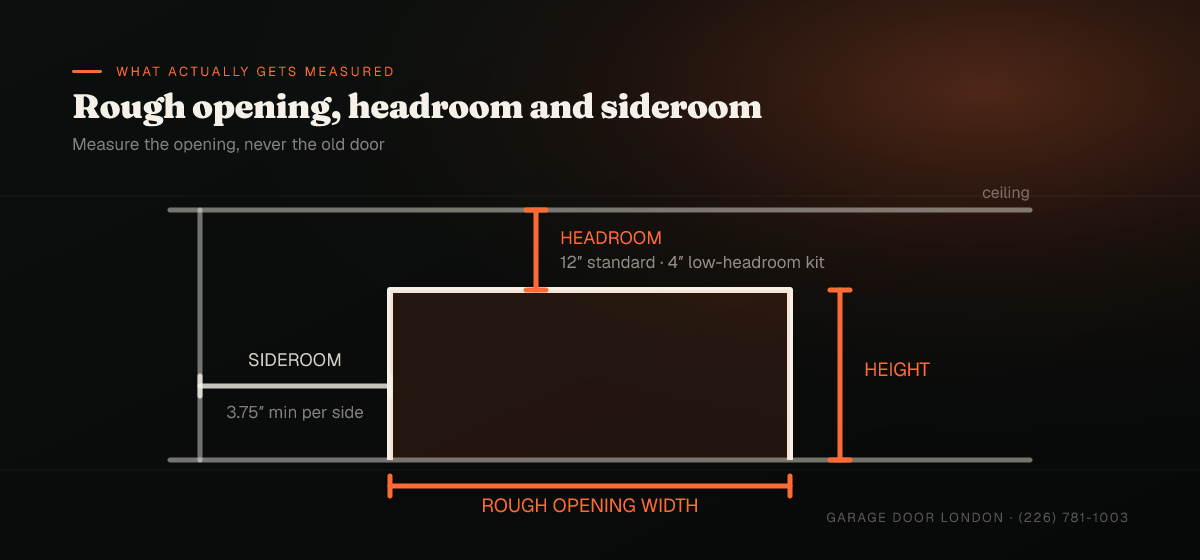
Headroom is what catches people out. Plenty of London garages — especially converted or under-house garages — have ductwork, a beam, or simply a low ceiling above the opening. Standard torsion hardware wants about 12 inches; low-headroom kits work in as little as 4 to 6, at the cost of a slightly more complex track and, on a heavy custom door, sometimes a jackshaft operator mounted on the wall rather than a rail on the ceiling.
Floor level is the sneaky one. A concrete slab that has settled 20 mm across a 16-foot opening will leave a visible wedge of daylight under a perfectly square door. That is solved with a custom-cut bottom section or a stepped seal, and it needs deciding before the order goes in, not after the door arrives.
We measure every custom order ourselves, on site, and the measurements go on the quote. It is not a step worth doing over the phone.
Custom garage door cost and lead times in London, Ontario
Prices below are 2026 installed figures for the London area, including removal and disposal of the old door and standard hardware. Openers are separate unless stated.
| Door | Installed price | Lead time |
|---|---|---|
| Stock steel sectional (reference) | $1,890 – $3,800 | 1 – 3 weeks |
| Non-standard size, steel | $2,600 – $4,800 | 4 – 8 weeks |
| Contemporary flush / long panel | $3,200 – $5,600 | 4 – 8 weeks |
| Carriage house, composite overlay | $3,800 – $7,200 | 5 – 10 weeks |
| Full-view aluminium and glass | $4,500 – $9,500 | 6 – 10 weeks |
| Real wood, overlay or solid | $6,500 – $14,000+ | 8 – 12 weeks |
| Low-headroom or high-lift conversion | +$400 – $1,600 | Added to the above |
| Jackshaft (wall-mount) operator | +$750 – $1,400 | In stock |
Three cost drivers people underestimate:
- Weight drives the whole hardware package. A heavy carriage-house or full-view door needs higher-rated springs, heavier track and often a stronger operator. That is a genuine cost, not an upsell — a heavy door on light springs will destroy an opener. See our spring systems guide.
- Insulation is a real decision on an attached garage. R-16 or better makes a measurable difference in a London winter and is worth specifying at order time. Our insulated garage door cost guide has the numbers.
- Lead time is not negotiable once ordered. Custom doors are built to order, so a factory queue is a factory queue. If your existing door is failing, budget for keeping it running — or replacing a spring — while you wait.
If the header is sagging, the jambs are rotten, or the slab has cracked across the opening, fix that first. A custom door built to a compromised opening will bind, wear unevenly and never seal properly — and the door is not returnable. We check the opening structure as part of measuring, and we will tell you if it needs work before an order goes in.
What happens on installation day
A custom door install is a half to full day depending on size, style and whether new track or an operator is going in. The sequence is consistent.
- The old door comes out. Springs are unloaded first — this is the point in the job that requires the most care — then the door is taken down section by section, and the old track, brackets and hardware are removed.
- The opening is checked and prepared. Jambs are inspected for rot and squareness, and the header is checked for the fixings the new track will take. Anything unsound is flagged before the new door goes up.
- The bottom section is set and levelled. Everything above it references this section, so it is set against the floor, not against the header — particularly on a sloped slab.
- Sections and track go up together, with hinges and rollers fitted joint by joint as the door is stacked.
- Springs are wound to the measured door weight. On a custom door this is calculated for the door as built, including overlays and glass, not taken from a chart.
- The operator is fitted or reconnected, and force and travel limits are set to the new door.
- Testing and handover. Balance test, auto-reverse test, photo-eye function, seal contact along the floor, and a walk-through of the manual release and warranty paperwork.
Old door disposal is included. If you are keeping the existing opener, we will tell you honestly whether it is up to the new door’s weight — on a heavy custom door it frequently is not, and our opener replacement guide covers what to look for.
Warranty and what to ask for in writing
A custom door should come with two separate warranties: the manufacturer’s cover on sections, finish and hardware — typically 10 years to lifetime on the panel, 3 to 5 on the finish, 1 to 5 on springs — and the installer’s workmanship warranty. Get both in writing, and check specifically what the finish warranty says about fading, because that is where custom colours differ from standard ones.
Garage Door London installs custom doors across London, Byron, Masonville, Old North, Hyde Park and the surrounding communities. See new garage door installation for the standard-door process, new garage door cost for stock pricing, or request an installation quote to get an on-site measure booked.
Get a flat-rate price in minutes
Frequently asked questions
Custom garage doors run $3,200 to $9,500 installed for most projects, against $1,890 to $3,800 for a stock steel door. A non-standard size in steel is $2,600 to $4,800, carriage house with composite overlay $3,800 to $7,200, full-view aluminium and glass $4,500 to $9,500, and real wood $6,500 to $14,000 or more.
Four to twelve weeks depending on what is being customised. Non-standard sizes and custom colours are typically 4 to 8 weeks, carriage house and full-view 5 to 10 weeks, and real wood 8 to 12 weeks. Custom doors are built to order, so lead times cannot be shortened once the order is placed.
Three things: a non-standard size where the opening does not match the 8, 9, 16 or 18-foot stock widths; a custom style such as carriage house, full-view glass or real wood; or a custom colour, finish or glazing outside the manufacturer's standard range. Custom hardware such as low-headroom or high-lift track also counts.
Measure the rough opening width at top, middle and bottom; the rough opening height at both sides; the headroom from the header to the ceiling; the sideroom from each opening edge to the nearest obstruction; the backroom from the opening to the back wall; and the floor level across the opening. Always measure the opening, never the existing door.
About 12 inches above the opening for standard torsion hardware. Low-headroom track kits work in as little as 4 to 6 inches, though on a heavy custom door that often means a wall-mounted jackshaft operator instead of a ceiling-mounted rail. Sideroom needs a minimum of 3.75 inches per side.
On London's older brick housing stock it is the style that delivers the biggest curb appeal gain, and composite overlays hold up far better than real wood through freeze-thaw. It does add real weight, which means a heavier spring specification and sometimes a stronger opener — factor that into the budget.
Only with insulated glazing units specified at order time. A standard single-glazed full-view door has poor insulation value and will be felt inside the house on an attached garage through a London winter. On a detached garage or workshop it is much less of an issue.
Sometimes. Reframing to take a stock door can be cheaper where the header and the structure above it allow it, but on a masonry opening it rarely does. We check the structure during the on-site measure and give a straight answer on which is the better spend.
Often not. Carriage house overlays, full-view glass and real wood are all significantly heavier than a stock steel door, and an underpowered opener fighting a heavy door fails early. We assess the existing operator during the measure and tell you honestly whether it needs replacing.
Two separate warranties. The manufacturer covers sections, finish and hardware — typically 10 years to lifetime on panels, 3 to 5 years on the finish and 1 to 5 years on springs. The installer covers workmanship. Get both in writing, and read the finish warranty carefully because custom colours are sometimes covered differently from standard ones.
What we put in writing
A fixed price before we start. The full price in writing after the diagnosis and before any work begins. Find something unexpected once the door is open and we stop and re-quote rather than adding it to your bill.
A written warranty. Lifetime on the parts we supply and five years on our labour, printed on the invoice rather than promised at the door.
A safety test before we leave. Balance, cables, drums, opener force and travel limits, and the auto-reverse tested against an obstruction — recorded on your invoice with the date.