Garage Door Balance Adjustment and Alignment: Testing, Causes and Fixes
Balance is the quietest fault a garage door has. Nothing breaks, nothing bangs, and the door keeps working — it just starts making the opener do a job the springs are supposed to do. Left alone, that is how a $150 adjustment turns into a $600 opener replacement. Here is how to test for it in ninety seconds, and what to do with the answer.

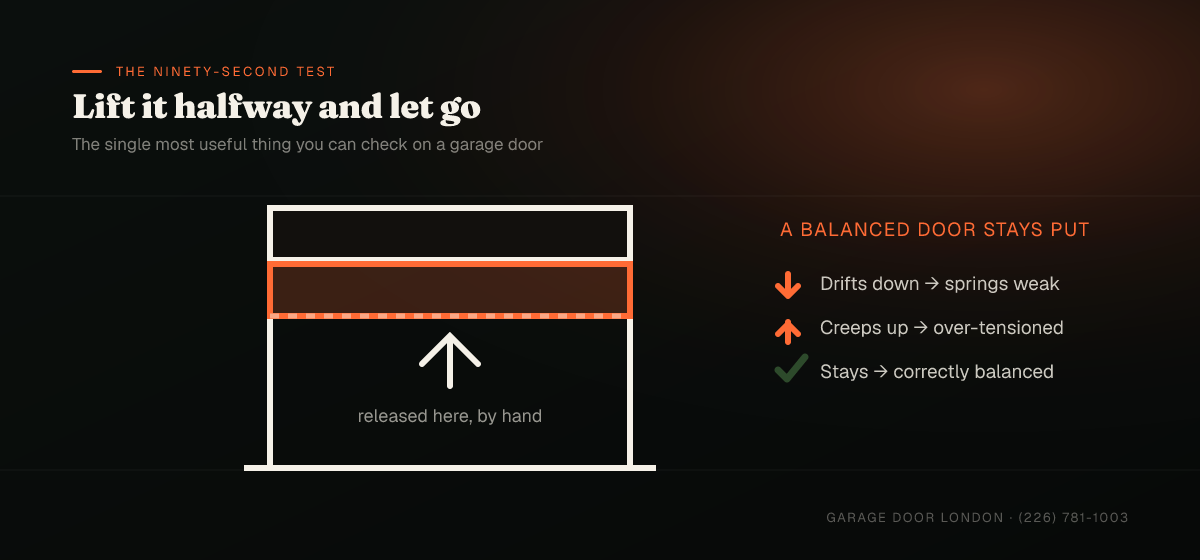
To test garage door balance: close the door fully, pull the red emergency release cord to disconnect the opener, lift the door by hand to about waist height, and let go. A correctly balanced door stays exactly where you left it. If it slides down, the springs are weak; if it pulls upward, they are over-tensioned. Either result means the opener has been compensating. Professional balance adjustment in London costs $120 to $220; where the springs are simply worn out, replacement at $200 to $480 is the real fix.
Balance and alignment are two different faults
They get used interchangeably and they are not the same thing, which matters because the fixes are entirely different.
Balance is a vertical question: are the springs carrying the door’s weight correctly? A balanced door feels almost weightless by hand and stays wherever you put it. An unbalanced door is either too heavy (weak springs) or wants to fly up (over-tensioned springs).
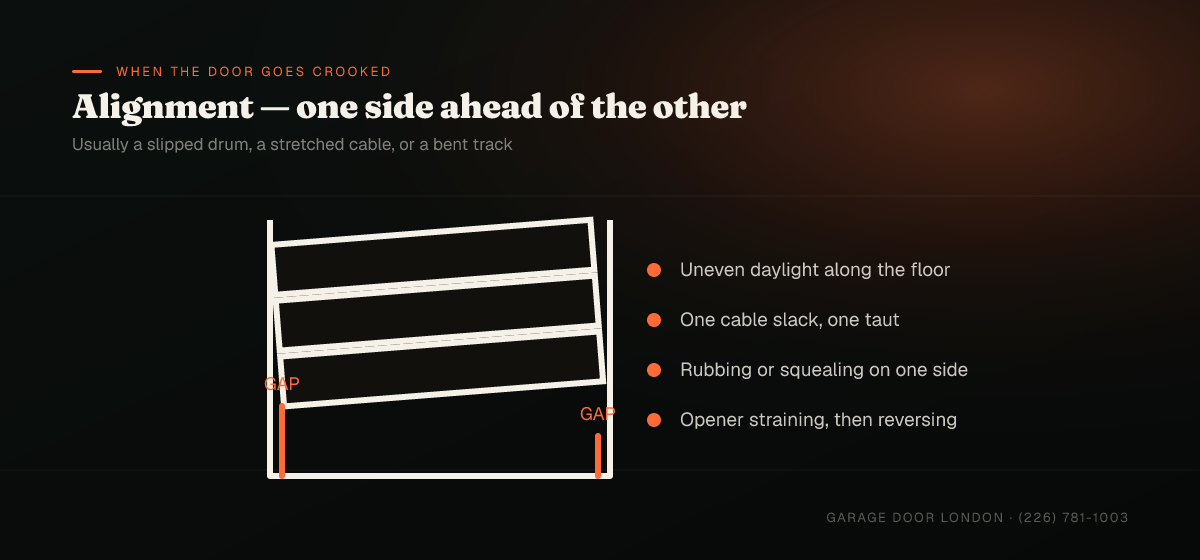
Alignment is a geometric question: is the door travelling square in its tracks? A misaligned door sits crooked, shows uneven daylight along the floor, and rubs on one side. That is a cable, drum or track problem, not a spring-tension problem.
| Balance fault | Alignment fault | |
|---|---|---|
| What you notice | Door feels heavy or wants to rise | Door sits crooked, uneven gap at the floor |
| Opener behaviour | Strains, hesitates, or reverses near the floor | Binds and reverses partway, often at the same point |
| Root cause | Springs weak, over-tensioned, or wrong size | Slipped drum, stretched cable, bent or loose track |
| Sound | Motor labouring | Scraping or squealing on one side |
| Test | Halfway hold test by hand | Measure the gap at each bottom corner |
| Typical repair | Spring adjustment or replacement | Drum, cable or track service |
| Typical cost | $120 – $480 | $150 – $350 |
They do feed each other. A door that has run out of balance for years puts uneven load through the cables and drums, and that eventually pulls it out of alignment too — which is why an old, heavy door often has both faults at once.
How to test your garage door's balance in ninety seconds
No tools, no cost, and it is the most informative ninety seconds you can spend on a garage door. Manufacturers recommend running it monthly; twice a year is realistic for most households.
- Close the door completely. This is not optional — see the warning below.
- Unplug the opener so it cannot be triggered while you are working.
- Pull the red emergency release cord to disconnect the door from the opener carriage.
- Lift the door by hand to about waist height. It should feel manageable — roughly 8 to 12 lb of effort on a properly sprung door, whatever the door actually weighs.
- Let go and watch. A balanced door stays put. A door that drifts down has weak springs. A door that pulls upward is over-tensioned.
- Lower the door by hand, plug the opener back in, and re-engage the carriage by running one cycle with the remote.
Releasing a raised door disconnects it from the opener while gravity is still holding it up. If a spring is broken or badly weakened, the door drops. Always close the door completely first. If the door is already stuck open and feels heavy or uneven, do not touch the cord at all — call for emergency service on (226) 781-1003.
If the door is so heavy you cannot lift it at all, stop. That is a broken spring, not a balance issue, and the door should be left alone until a technician has been. Our broken spring guide covers what happens next.
What throws a garage door out of balance or alignment
Six causes account for nearly everything we see across London.
- Springs past their cycle life. A torsion spring loses tension gradually across its rated cycles — it does not go from perfect to broken. The last year or two of a spring’s life is spent under-supporting the door. See how long springs last.
- The wrong spring fitted. A spring sized for a lighter door will never balance a heavier one. This turns up constantly on doors where insulation was added later, or where a previous repair used whatever was on the van.
- A slipped cable drum. A loose set screw lets one drum turn independently of the shaft, so one cable winds further than the other and the door goes out of square.
- A stretched or damaged lift cable. Cables elongate slightly with age and corrosion. A few millimetres of difference between sides is enough to show as a visible gap at the floor.
- Bent or loose track. A knock from a bumper, or lag bolts that have worked loose in the framing, and the track no longer holds the door square.
- Seasonal movement. London’s freeze-thaw cycle moves garage framing more than people expect. Doors that were fine in September can bind slightly by February — our cold weather guide covers the winter side.
Measuring alignment yourself
With the door closed, measure the gap between the bottom of the door and the floor at each corner and at the centre. On a square door the three readings should be within a few millimetres of each other. A difference you can see at a glance — a visible wedge of daylight at one corner — means one side is travelling further than the other, and that is a drum or cable issue in the large majority of cases. Our cable and drum service covers the fix, and the cable repair guide goes deeper.
Why an unbalanced door is expensive to ignore
An unbalanced door keeps working. That is exactly the problem — there is no dramatic failure to force the issue, so it runs like that for years while the cost accumulates somewhere else.
A garage door opener is designed to guide a balanced door, not lift a heavy one. The springs are meant to offset essentially all of the weight; the opener supplies enough force to overcome friction and to control the travel. When the springs weaken, the opener silently takes over the difference — and a residential opener asked to lift 40 or 50 lb of unsupported weight, 1,500 times a year, does not last.
| Component | On a balanced door | On an unbalanced door |
|---|---|---|
| Opener motor and gears | 12 – 18 years | 6 – 10 years |
| Drive chain or belt | Full service life | Stretches and slips early |
| Rollers | 8 – 12 years (nylon) | Wear unevenly, flat-spot early |
| Hinges and section joints | 20+ years | Elongated holes, cracked sleeves |
| Cables | 8 – 12 years | Fray at the drum from uneven load |
| Springs | Reach their rated cycles | Fail early, often the remaining one first |
| Safety auto-reverse | Reliable | Force settings creep up to compensate |
The last row is the one that should decide it. When a door gets heavy, the common “fix” is to turn up the opener’s down-force so it stops reversing. That defeats the contact-reversal safety system entirely — the door will now push through an obstruction rather than reversing off it. If someone has adjusted your force settings to stop nuisance reversals, the door needs balancing, not more force. Our safety inspection guide covers how that gets tested.
What a professional balance adjustment involves, and what it costs
Balance adjustment on a torsion door means changing the number of turns of tension on the spring, which is done with winding bars against a loaded spring. It is precise work and it is genuinely dangerous done wrong — this is the part of the job that sends people to hospital. It is not a DIY task on either spring system.
A typical visit runs like this: the technician weighs or estimates the door, clamps it, unloads the spring, sets the correct turns for the measured weight, re-checks by hand at three heights, corrects any drum or cable difference that has crept in, then resets the opener’s force and travel limits and finishes with an auto-reverse test.
| Job | Typical price | Time on site |
|---|---|---|
| Balance adjustment (spring re-tension) | $120 – $220 | 45 – 75 min |
| Track realignment | $150 – $300 | 45 – 90 min |
| Cable re-set / re-wind on drums | $150 – $280 | 45 – 90 min |
| Drum replacement (pair) with cables | $250 – $420 | 90 – 150 min |
| Spring replacement (when adjustment will not hold) | $200 – $480 | 45 – 90 min |
| Balance adjustment added to a tune-up | +$60 – $120 | +20 – 30 min |
An honest caveat about adjustment. Re-tensioning buys back balance only while the spring still has usable life. On a spring near the end of its rated cycles, adding turns is a short-term fix that will not hold and slightly accelerates the failure. A technician who tells you the springs need replacing rather than adjusting is usually telling you the truth — our torsion vs extension guide explains how cycle ratings work, and spring repair cost covers the pricing.
If the door is still binding after balance and alignment are both correct, the fault is usually in the track or the opener travel limits — see track repair and why a garage door stops halfway.
Garage Door London handles balance and alignment work across the region — Byron, Masonville, Westmount, Old North and beyond. Every visit finishes with a balance test and a written record. Request a flat-rate quote or read our customer reviews.
Get a flat-rate price in minutes
Frequently asked questions
Close the door fully, unplug the opener, pull the red emergency release cord, then lift the door by hand to waist height and let go. A balanced door stays exactly where you left it. If it slides down the springs are weak; if it pulls upward they are over-tensioned.
A balance adjustment costs $120 to $220 and takes 45 to 75 minutes. Added to a tune-up it is $60 to $120 more. Where the springs are past their cycle life and adjustment will not hold, replacement at $200 to $480 is the real fix.
Balance is about whether the springs are carrying the door's weight — an unbalanced door feels heavy or wants to fly up. Alignment is about whether the door travels square in its tracks — a misaligned door sits crooked with uneven daylight along the floor. Different causes, different repairs.
Usually a cable drum has slipped on the torsion shaft or one lift cable has stretched, so one side travels further than the other. Bent or loose track is the other common cause. Measure the gap at each bottom corner: a visible difference means a drum, cable or track fault.
No. Balance adjustment on a torsion door means changing the tension on a loaded spring using winding bars, and this is the part of garage door work that causes the most serious injuries. Both torsion and extension spring tension should be adjusted by a trained technician.
The opener quietly takes over the lifting the springs should be doing. A residential opener asked to lift 40 to 50 pounds of unsupported weight 1,500 times a year typically lasts 6 to 10 years instead of 12 to 18. Rollers, hinges, cables and the remaining spring all wear faster too.
No. Increasing the down-force to stop nuisance reversals defeats the contact-reversal safety system — the door will push through an obstruction rather than reversing off it. Nuisance reversals almost always mean the door has become heavy and needs balancing, not more force.
Manufacturers recommend monthly; twice a year is realistic for most households, and it is included in any proper annual tune-up. It takes about ninety seconds and needs no tools.
About 8 to 12 pounds of effort to lift, regardless of what the door actually weighs — a double door can weigh 150 pounds and still feel light when the springs are set correctly. If it takes real effort, the springs are no longer carrying their share.
Indirectly, yes. Freeze-thaw movement shifts garage framing and stiffens grease, so a door that was fine in September can bind slightly by February. Cold also makes spring steel more brittle, which is why marginal springs tend to fail in January and February.
What we put in writing
A fixed price before we start. The full price in writing after the diagnosis and before any work begins. Find something unexpected once the door is open and we stop and re-quote rather than adding it to your bill.
A written warranty. Lifetime on the parts we supply and five years on our labour, printed on the invoice rather than promised at the door.
A safety test before we leave. Balance, cables, drums, opener force and travel limits, and the auto-reverse tested against an obstruction — recorded on your invoice with the date.