Garage Door Safety Inspection in London, Ontario: The 12-Point Check
A garage door is the only appliance in a house heavy enough to kill somebody, and the safety systems that stop it doing so are two small sensors and a force setting that nobody ever checks. An inspection is the half-hour that confirms all of it still works. Here is the full checklist, the three tests you can run yourself this afternoon, and the standards a door is actually being measured against.

A garage door safety inspection in London, Ontario costs $90 to $160 and takes about 30 to 45 minutes. It is a diagnostic visit, not a repair: the technician tests the auto-reverse on contact, the photo-eye sensors, the door balance and the opener force settings, inspects springs, cables, drums, rollers and track for wear, and leaves a written pass/fail report. You can run the three core tests yourself in five minutes — a door that fails any of them should not be used until it is fixed.
What is a garage door safety inspection — and how is it different from a tune-up?
The two get used interchangeably, and they should not be. The difference is what you walk away with.
A tune-up is corrective work: the technician lubricates, tightens, adjusts and aligns, and the door leaves in better condition than it arrived. A safety inspection is diagnostic: the technician tests and documents, and you leave with a written record of what passed, what failed, and what it would cost to put right. Nothing is adjusted unless you ask for it.
In practice most London homeowners want the tune-up, because a door that fails an inspection needs fixing anyway. The inspection stands on its own when you need documentation — a home sale, a rental property, an insurance question, or a landlord’s duty of care. We cover the corrective side in our maintenance and tune-up guide.
The 12-point garage door safety inspection checklist
Here is the full list, in the order a technician works through it, with the criterion each point is judged against. Six of the twelve are safety-critical — a fail on any of those means the door should be taken out of service until it is repaired.
| # | Check | Pass criterion | Safety-critical |
|---|---|---|---|
| 1 | Auto-reverse on contact | Reverses within about 2 seconds of striking an obstruction | Yes |
| 2 | Photo-eye sensors | Beam break reverses the door instantly; both LEDs steady | Yes |
| 3 | Sensor mounting height | No more than 6 inches above the floor, securely fixed | Yes |
| 4 | Door balance | Holds position unaided at waist height, opener disconnected | Yes |
| 5 | Springs | No gaps, coil separation, rust pitting or exceeded cycle rating | Yes |
| 6 | Lift cables and bottom brackets | No broken strands or corrosion; brackets undisturbed | Yes |
| 7 | Opener down-force setting | No higher than the door genuinely requires | No |
| 8 | Travel limits | Door seals at the floor without straining or gapping | No |
| 9 | Rollers, hinges and fasteners | No seized rollers, elongated holes or missing bolts | No |
| 10 | Track condition and alignment | Straight, plumb, correct clearance, lags tight | No |
| 11 | Manual release cord | Releases and re-engages cleanly, cord at safe height | No |
| 12 | Wall control and remotes | Wall button at least 5 feet up; remotes paired and secure | No |
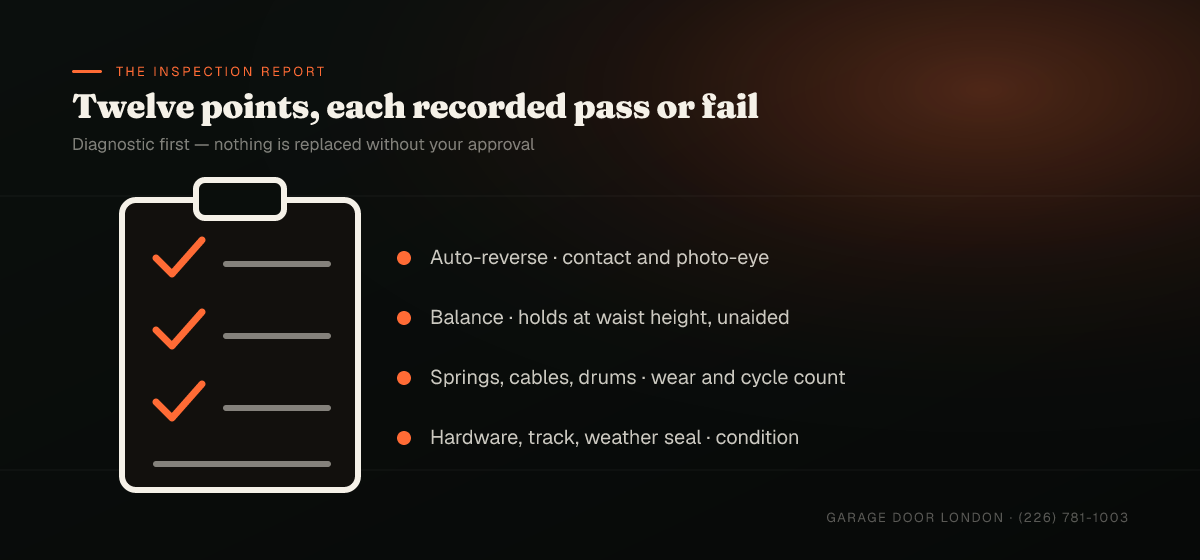
Points 5 and 6 are where most older London doors lose marks, and they are also the two nobody can assess from the ground. A spring that is past its rated cycles looks perfectly fine right up until it does not, and cable fraying starts at the bottom bracket where it is hardest to see. If either comes back marginal, our spring repair and cable repair pages set out what replacement involves.
Three garage door safety tests you can run yourself in five minutes
You do not need a technician to find the most dangerous faults. These three tests take five minutes between them, need no tools, and are worth running every few months — the manufacturers recommend monthly.
1. The auto-reverse (contact) test
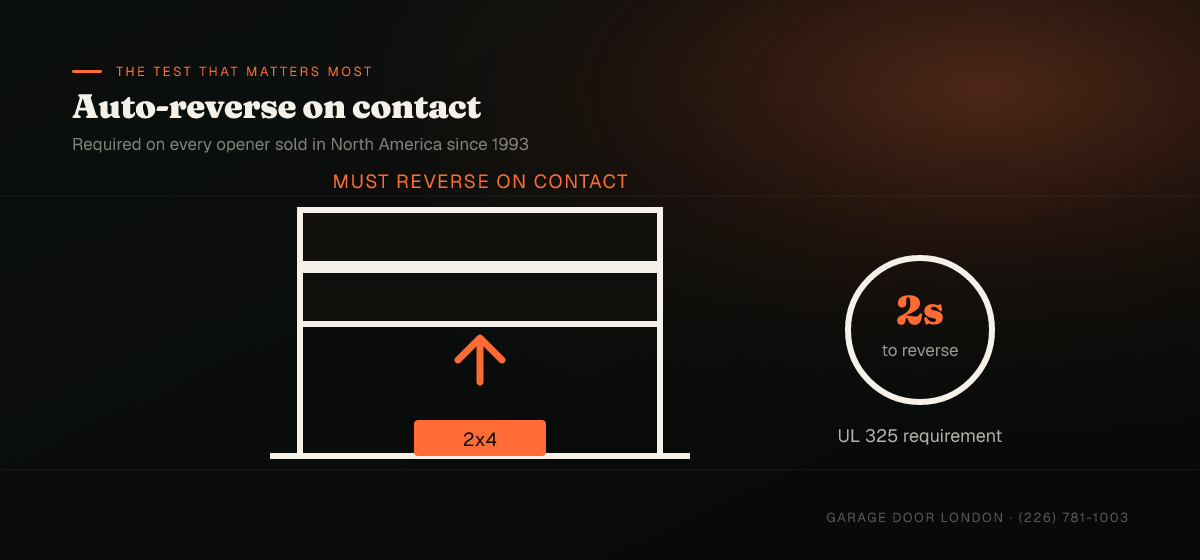
Lay a flat 2x4 on the floor, on its side, directly under the centre of the door. Close the door with the remote. When the bottom of the door hits the timber, it should stop and reverse within about two seconds. If it keeps pushing, stalls against the wood, or reverses only after a struggle, the down-force is set too high and the door is unsafe. Stop using it and get the setting corrected.
2. The photo-eye test
Start the door closing, then wave a broom handle through the beam near the floor — never your arm or leg. The door should reverse immediately, before anything touches it. If it hesitates, if the opener light blinks, or if nothing happens at all, the sensors are misaligned, dirty, or wired badly. That is usually a ten-minute fix and our safety sensor guide walks through it.
3. The balance test
With the door fully closed, pull the red emergency release cord to disconnect the opener. Lift the door by hand to about waist height and let go. A correctly balanced door stays where you put it. If it slides down, the springs have weakened; if it pulls upward, they are over-tensioned. Either way the opener has been compensating, and that shortens its life. Full detail in our balance and alignment guide.
Pulling the emergency release on a raised door disconnects it from the opener while gravity is still holding it up. If a spring is broken or weak, the door can drop. Close the door completely first, every time — and if the door is stuck open and unbalanced, leave the cord alone and call for emergency service.
Fail any of the three and the door should be taken out of service until it is corrected. Fail the balance test in particular and you are on borrowed time with the springs — that is the fault that turns into an after-hours call.
What standards is a garage door being measured against?
The pass criteria above are not house rules. They come from the safety standards every opener sold in North America is built to, and knowing them helps you tell a real inspection from a sales visit.
| Standard / rule | What it requires | Applies to |
|---|---|---|
| UL 325 (1993 onward) | Two independent reversal systems: contact reversal plus a non-contact device such as photo-eyes | Every residential opener sold since 1 January 1993 |
| Photo-eye mounting | Sensors no more than 6 inches above the floor | All openers with photo-eyes |
| Contact reversal timing | Door must reverse promptly on striking a 1.5-inch obstruction | All automatic openers |
| Extension spring containment | A safety cable through the centre of every extension spring | Doors with extension springs |
| CSA / ANSI DASMA 102 | Construction, wind load and operational requirements for sectional doors | New door installation |
| Wall control height | Push button mounted at least 5 feet above the floor, out of a child's reach | All openers |
| Ontario Building Code | Fire separation requirements for the door between an attached garage and the house | Attached garages |
Two of these catch people out regularly in London’s older housing stock. The first is the 1993 line: openers older than that were built before photo-eyes were mandatory, and a good number are still running in Old North, Wortley Village and the mid-century streets around Westmount. There is no legal requirement to retrofit a residential opener, but a pre-1993 unit has exactly one reversal system instead of two, and that is a genuinely different risk profile. Our opener replacement guide covers what a modern unit adds.
The second is extension spring containment. If your door has springs stretched along the horizontal tracks rather than a single spring above the opening, each one needs a safety cable running through its centre so a failed spring cannot become a projectile. It is inexpensive, it is often missing on older installs, and it is the first thing we check on an extension-sprung door. Our torsion vs extension spring guide explains how to tell which system you have.
When should you book a garage door inspection?
Annually is the sensible default, in the same visit as the tune-up. Beyond that, there are six moments when an inspection genuinely earns its fee:
- Buying or selling a home. A home inspector will note the door but rarely tests balance, force settings or spring cycle life. A documented door inspection removes a negotiating point before it becomes one.
- Taking on a rental property. A landlord in Ontario carries a duty of care for the equipment supplied with the unit. A dated inspection report is the evidence that duty was met.
- Moving into a house with an unfamiliar door. You have no idea how old the springs are or how many cycles they have done. Half an hour tells you where you stand.
- After any impact. A bumper against the bottom section bends more than the panel. Track, rollers and the bottom bracket all take load in a strike. See panel replacement.
- When small children or pets start using the garage. This is the point at which the auto-reverse and photo-eye tests stop being theoretical.
- Before winter, on any door over ten years old. Cold finds tired springs. Finding them in October is a scheduled job; finding them in January is an emergency call-out.
What an inspection costs in London
| Service | Typical price | What you receive |
|---|---|---|
| Safety inspection, single door | $90 – $160 | 12-point written pass/fail report |
| Inspection + tune-up combined | $160 – $240 | Report plus corrective service |
| Second door, same visit | +$50 – $90 | Separate report per door |
| Pre-sale / real estate inspection | $120 – $190 | Dated report suitable for a file |
| Commercial or multi-bay | Quoted per door | Per-door report and service log |
Where an inspection is followed by repair work in the same visit, we roll the inspection fee into the job. And whatever a report turns up, you get the price before anything is fitted — that is the whole point of separating diagnosis from repair.
We inspect doors right across the region, from Masonville and Byron out to St. Thomas and Woodstock. Garage Door London is fully insured — more on the team on our about page, and you can book an inspection here.
Get a flat-rate price in minutes
Frequently asked questions
A 12-point safety inspection on a single door costs $90 to $160 and takes 30 to 45 minutes. Combined with a tune-up it runs $160 to $240. A dated pre-sale report is $120 to $190. Where repair work follows in the same visit, the inspection fee is rolled into the job.
An inspection is diagnostic: the technician tests and documents, and you receive a written pass/fail report plus a quote for anything found. A tune-up is corrective: lubrication, tightening, alignment and adjustment are carried out on the visit. Most homeowners book both together.
Lay a flat 2x4 on its side on the floor under the centre of the door and close the door with the remote. The door must stop and reverse within about two seconds of touching the timber. If it keeps pushing or stalls, the down-force setting is too high and the door is unsafe to use.
Close the door fully, pull the red emergency release cord to disconnect the opener, then lift the door by hand to waist height and let go. A balanced door stays put. If it drifts down the springs are weakening; if it pulls upward they are over-tensioned.
Manufacturers recommend testing the auto-reverse and photo-eye sensors monthly. It takes about two minutes. A full professional inspection is worth booking annually, and always after any impact to the door.
Every residential garage door opener sold in North America since 1 January 1993 has been built to UL 325, which requires two independent reversal systems — contact reversal plus a non-contact device such as photo-eyes. There is no requirement to retrofit an older opener, but a pre-1993 unit has only one reversal system and is meaningfully less safe.
It is not required, but it is useful. Home inspectors note the door without testing balance, force settings or spring cycle life, so a documented door inspection settles the question before it becomes a negotiating point. A dated report costs $120 to $190.
Six results are treated as critical fails: the door does not reverse on contact, the photo-eyes do not reverse it, the sensors are mounted above six inches, the door will not hold its balance, a spring shows gaps or coil separation, or a lift cable has broken strands. Any of these means the door should be taken out of service until repaired.
Yes. Every extension spring should have a safety cable running through its centre and anchored at both ends so that a failed spring cannot fly across the garage. It is inexpensive and frequently missing on older London installations — it is the first thing we check on an extension-sprung door.
Yes. Commercial and multi-bay doors are inspected per door with an individual report and service log, priced on cycle volume and door type. High-cycle bays generally warrant quarterly inspection rather than annual.
What we put in writing
A fixed price before we start. The full price in writing after the diagnosis and before any work begins. Find something unexpected once the door is open and we stop and re-quote rather than adding it to your bill.
A written warranty. Lifetime on the parts we supply and five years on our labour, printed on the invoice rather than promised at the door.
A safety test before we leave. Balance, cables, drums, opener force and travel limits, and the auto-reverse tested against an obstruction — recorded on your invoice with the date.