Garage Door Maintenance and Tune-Up in London, Ontario: What's Included, What It Costs
A garage door is the largest moving object in most London homes, and it runs roughly 1,500 times a year without anyone thinking about it. A tune-up is simply the hour that keeps that from becoming a 2 a.m. problem. Here is exactly what a professional service covers, what it costs in 2026, and the handful of jobs worth doing yourself in between.

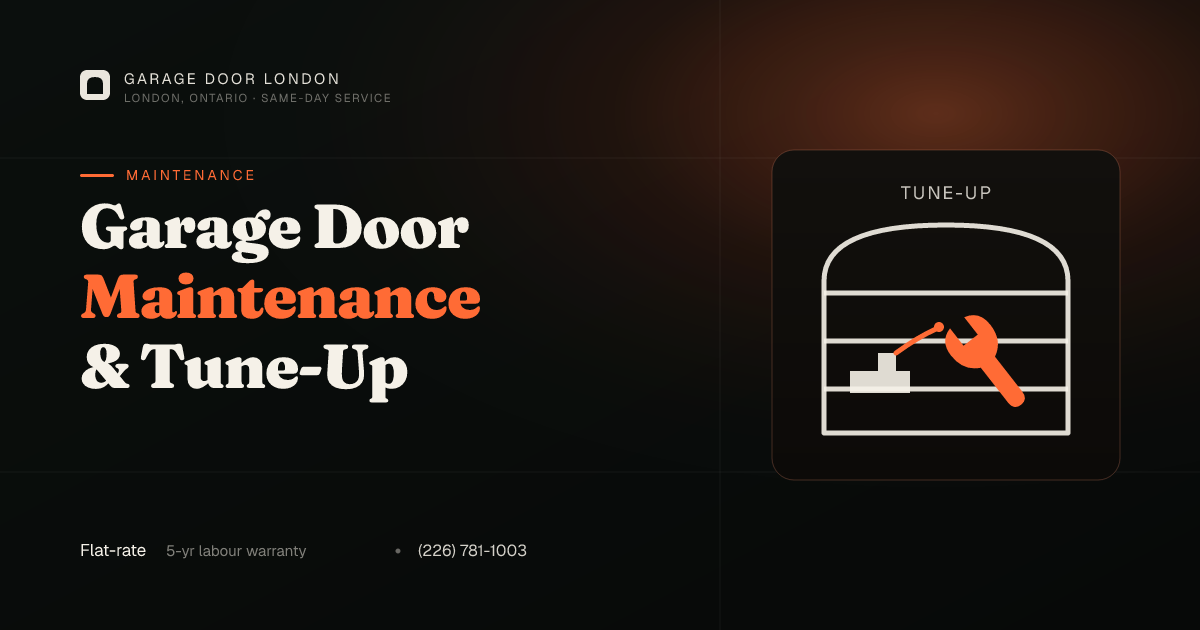
A professional garage door tune-up in London, Ontario costs $120 to $190 and takes about 45 to 75 minutes. It covers lubrication of hinges, rollers, springs and bearings, tightening every fastener, a door balance test, cable and drum inspection, track alignment, and a full safety test of the auto-reverse and photo-eye sensors. Most London homes should book once a year — ideally in autumn, before the freeze-thaw season that causes the majority of winter failures.
What does a garage door tune-up actually include?
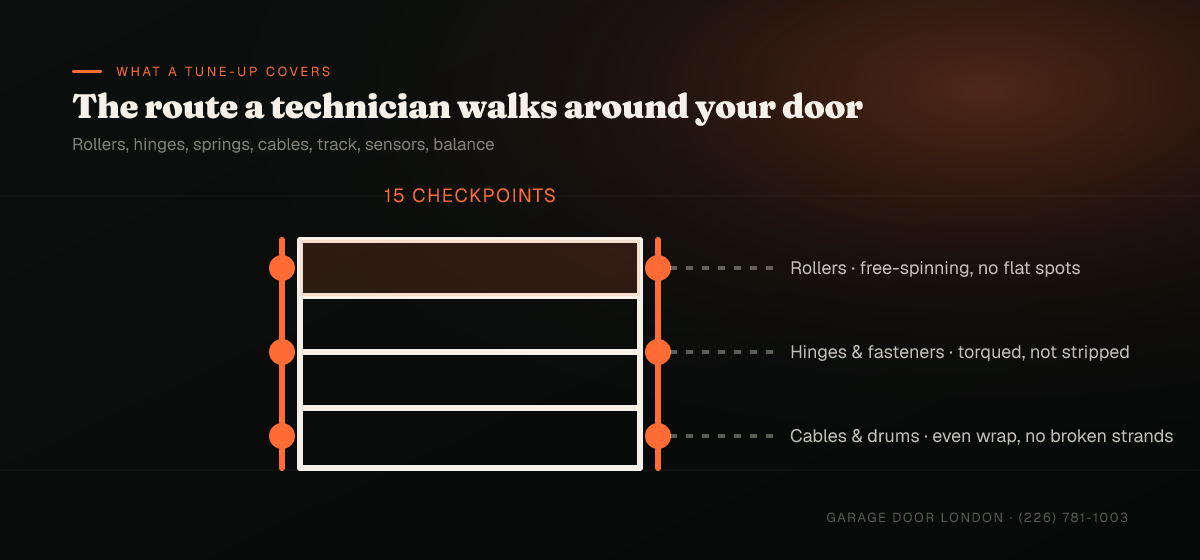
“Tune-up” is one of those trade words that can mean anything from a genuine hour of work to a squirt of oil and an invoice. So it is worth being specific. A proper preventative maintenance visit is a fixed route around the door, and the technician follows it whether or not anything is currently misbehaving — the entire point is to find the failure before it finds you.
Here is the fifteen-point service we run on a standard residential door in London, and what each step is actually looking for.
| # | Checkpoint | What the technician is looking for |
|---|---|---|
| 1 | Door balance test | Door held at waist height should stay put with the opener disconnected |
| 2 | Spring condition & cycle estimate | Gaps, rust, coil separation, age against rated cycles |
| 3 | Lift cables | Broken strands, fraying at the bottom bracket, corrosion |
| 4 | Cable drums | Even wrap, set screws tight, drum not slipping on the shaft |
| 5 | End bearings & centre bearing | Play in the shaft, rumble, dry bearings |
| 6 | Rollers | Flat spots, seized bearings, stem wear, wobble in the track |
| 7 | Hinges & fasteners | Elongated holes, missing bolts, cracked section joints |
| 8 | Vertical & horizontal track | Alignment, dents, loose lag bolts, correct clearance |
| 9 | Lubrication | Hinges, roller stems, spring coils and bearings — not the track |
| 10 | Photo-eye sensors | Alignment, lens condition, steady LEDs, wire staples |
| 11 | Auto-reverse (contact) test | Door must reverse within about 2 seconds of hitting an obstruction |
| 12 | Opener force & travel limits | Down force set no higher than the door actually needs |
| 13 | Chain, belt or screw drive | Tension, wear, lubrication of the rail |
| 14 | Weather seal & bottom seal | Cracking, gaps at the corners, daylight along the floor |
| 15 | Manual release & emergency cord | Releases cleanly, re-engages, cord at the right height |
Two of those points do far more work than the rest. The balance test is the single best predictor of what your door is about to cost you: a door that will not hold its own weight is running on tired springs, and every cycle after that is being paid for by the opener. And the auto-reverse test is the one that matters if there are children, pets or a shared driveway involved — it is a safety requirement, not a nicety, and we cover it in detail in our garage door safety inspection guide.
A tune-up is deliberately not a repair visit. If we find a broken cable or a spring at the end of its life, we will quote it separately and let you decide — nothing gets replaced on a maintenance call without your say-so. That distinction is worth asking any company about before you book.
How much does garage door maintenance cost in London, Ontario?
Preventative maintenance is the cheapest line item in the whole garage door business, which is exactly why it gets skipped. In 2026 a standard residential tune-up in the London area runs $120 to $190, and a second door on the same visit is usually discounted because the technician, the ladder and the drive time are already there.
| Service | Typical price | Time on site |
|---|---|---|
| Single-door tune-up (15-point) | $120 – $190 | 45 – 75 min |
| Second door, same visit | +$70 – $110 | +30 – 45 min |
| Tune-up + safety inspection report | $160 – $240 | 60 – 90 min |
| Lubrication-only service call | $95 – $130 | 20 – 30 min |
| Roller replacement added to a tune-up | +$120 – $220 | +30 – 45 min |
| Annual plan (two visits, priority booking) | $210 – $290 / yr | — |
| Commercial / multi-bay maintenance | Quoted per door | Varies |
Set that against what it prevents. A tune-up costs roughly a third of a single spring replacement and about a fifth of a new opener. It will not make parts immortal — springs are a consumable and they will eventually go — but it reliably converts a surprise into a scheduled appointment, and after-hours surprises carry a premium that daytime appointments do not. Our repair cost guide lays out those numbers side by side.
How often should a garage door be serviced in London's climate?
The industry default is annual, and for most London homes that is right. But the honest answer depends on how hard the door works, and the number that matters is cycles — one cycle being a single open and close.
| Household | Rough cycles per year | Recommended service |
|---|---|---|
| Single vehicle, one adult, side entry used often | 500 – 800 | Every 18 – 24 months |
| Typical family, two vehicles, garage is the main door | 1,200 – 1,800 | Once a year |
| Teen drivers, shift work, home business | 2,500 – 4,000 | Every 6 – 9 months |
| Detached shop or unheated garage | Any | Once a year, in autumn |
| Commercial or multi-tenant bay | 5,000+ | Quarterly — see commercial service |
Why autumn is the right month in London
This is not a marketing preference. Steel loses ductility as it gets cold, grease stiffens, and metal contracts — which means the freeze-thaw swing London gets from December through March finds every weakness that was already there in October. Our call volume climbs sharply after the first hard frost, and the failures are rarely random: they are tired springs, dry bearings and a door that had been running slightly out of balance since summer.
Booking the tune-up in September or October gets the lubrication done before it is needed, catches the spring that is one cold snap from letting go, and lets you replace a perished bottom seal while the concrete is still dry enough to seat it properly. If you would rather work through the seasonal checks yourself first, our winter maintenance checklist is written specifically around this climate, and why your garage door won’t open in cold weather explains the failures we see most in January.
We run maintenance across the whole London region — Byron, Masonville, Hyde Park, White Oaks, Oakridge and Lambeth among them. The full list is on our service areas page.
What maintenance can you safely do yourself?
Plenty, as it happens — and doing it properly will genuinely extend the life of the door. The dividing line is simple and absolute: anything under spring tension is off limits. Springs, cables, the bottom brackets and the cable drums hold their energy whether the door is moving or not. Everything else on this list is fair game with a stepladder and ten minutes.
Lubrication: the ten minutes that does the most
Nine out of ten “my door got noisy” calls come down to dry hardware. Use a white lithium grease or a silicone-based garage door lubricant. Do not use WD-40 as a lubricant — it is a solvent and a water displacer, and it strips the grease you actually want on the part. It is fine for freeing a seized hinge, but follow it with a proper lubricant.
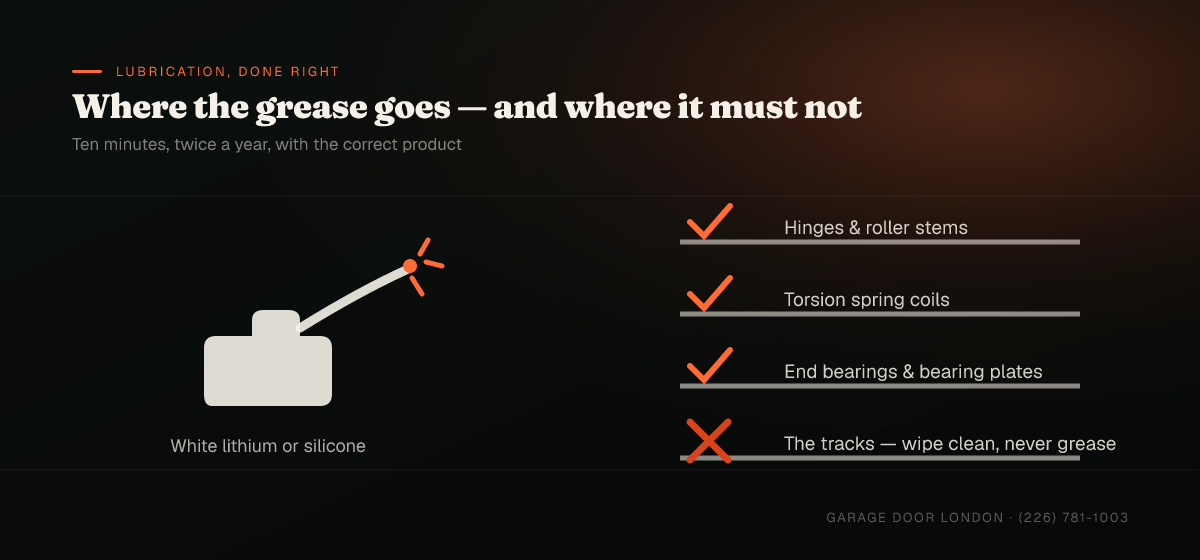
The one that surprises people: never grease the tracks. The rollers are meant to roll along a clean, dry surface. Grease in the track turns into an abrasive paste of dust and grit that chews through roller bearings. Wipe the tracks out with a rag and leave them dry.
If the door is still noisy after a proper lubrication, the noise is telling you something structural — usually worn rollers or a loose section. Our guides to fixing a noisy garage door and roller, hinge and bearing replacement decode what each sound actually means.
Seven signs your garage door is overdue for a tune-up
Doors give notice before they fail. Almost none of these are emergencies today, and almost all of them become one eventually.
- It has got louder. Grinding, squealing or a rhythmic clack usually means dry or worn rollers and hinges. New noise is always new wear.
- It jerks or shudders on the way up. Uneven travel points at a binding roller, a bent track section, or springs that have lost matched tension.
- It will not stay put when you lift it halfway by hand. Classic tired-spring symptom, and the clearest signal that a spring replacement is on the horizon. See our balance and alignment guide.
- One side sits lower than the other when closed. A cable is slipping on its drum or the door has drifted out of square. Left alone this pulls the door off its track.
- The opener strains, hesitates, or reverses for no reason. Usually the opener reporting that the door has become too heavy for it — not an opener fault at all.
- You can see daylight around the closed door. Perished seals, and in London that is a heating bill as well as a draught. See weather seal replacement.
- You cannot remember the last service. If nobody has been near it in three years, something on the list has gone quietly out of adjustment.
A single sharp crack from the garage almost always means a torsion spring has failed. Do not keep pressing the button — the opener is not built to lift an unbalanced door and you will burn it out on top of the spring. Unplug the opener, keep everyone clear, and book a repair. Our emergency line runs 24/7 on (226) 781-1003.
None of the seven need to become a call-out. Caught on a maintenance visit, most are a $0 adjustment or a part swapped while the technician is already on the ladder. Caught in February at 11 p.m., the same fault is an emergency repair.
Does a garage door tune-up actually pay for itself?
Fair question, and it deserves a real answer rather than a sales one. Maintenance does not stop springs from wearing out — springs are rated in cycles and they will reach the end of that rating no matter how well the door is kept. What maintenance does is stop everything else from wearing out early, and it changes when and how the inevitable happens.
| Component | Neglected door | Maintained door |
|---|---|---|
| Rollers | 2 – 4 years, noisy from year two | 8 – 12 years for sealed nylon |
| Springs | Fail early if the door runs out of balance | Reach their full rated cycle life |
| Cables | Fray against a slipping drum | Wear evenly, replaced on schedule |
| Opener motor | Strains against a heavy door, 8 – 12 years | 12 – 18 years on a balanced door |
| Hinges & sections | Elongated holes, cracked joints | Fasteners stay torqued, sections stay square |
| Failure timing | Unannounced, often after hours | Found on a scheduled visit |
| Typical 10-year spend | $1,400 – $2,200 | $1,000 – $1,500 including tune-ups |
The number that moves most is the opener. An opener asked to lift a poorly balanced door every day is doing work the springs are supposed to be doing, and it will die years early for it — which is a $400 to $750 replacement rather than a $155 service. Our opener replacement guide walks through when that spend becomes unavoidable.
What to ask before you book
Not all “tune-ups” are the same job. Before booking with anyone, ask three things: is the balance test included, is the auto-reverse safety test included, and will you be quoted separately for any parts rather than having them fitted automatically. A company that answers all three plainly is one worth having on the driveway. Ours are answered on the FAQ page, and you can see what London homeowners say on our reviews page.
Garage Door London services doors across the region, fully insured, and every maintenance visit carries a written record of what was checked and what we found. If a part needs replacing, you get the price before the tool comes out. Get in touch or request a quote to book.
Get a flat-rate price in minutes
Frequently asked questions
A 15-point tune-up on a standard residential door costs $120 to $190 and takes 45 to 75 minutes. A second door on the same visit adds $70 to $110. A tune-up combined with a written safety inspection report runs $160 to $240.
Once a year for a typical London family home running roughly 1,200 to 1,800 cycles. Light users can stretch to 18 to 24 months; households with teen drivers or shift work should book every 6 to 9 months. Commercial and multi-tenant bays are usually quarterly.
Lubrication of hinges, roller stems, spring coils and bearings; tightening every fastener; a door balance test; inspection of springs, cables, drums, rollers, hinges and track; weather seal check; photo-eye sensor alignment; the auto-reverse safety test; and a check of the opener force and travel limits.
Autumn, ideally September or October. London's freeze-thaw cycle from December through March finds every weakness that was already present, so getting lubrication, balance and seals sorted before the first hard frost prevents the majority of winter failures.
No, and any company that promises it is overselling. Springs are rated in cycles and will eventually reach the end of that rating. What maintenance does is keep the door balanced so the springs reach their full rated life rather than failing early, and it lets a technician spot a spring nearing the end so replacement can be scheduled instead of happening at 2 a.m.
Yes for lubrication, wiping the tracks, tightening visible hinge and bracket bolts, cleaning the photo-eye lenses and running the auto-reverse test. No for anything under spring tension: springs, cables, cable drums and the bottom brackets store enough energy to cause serious injury and need a trained technician.
Not as a lubricant. WD-40 is a solvent and water displacer that strips away the grease you want on the part. Use white lithium grease or a silicone-based garage door lubricant instead. WD-40 is fine for freeing a seized hinge, but follow it with a proper lubricant.
No. Rollers are designed to roll along a clean, dry track. Grease in the track collects dust and grit and turns into an abrasive paste that destroys roller bearings. Wipe the tracks clean with a cloth and leave them dry.
Yes. We maintain sectional doors from all the common North American manufacturers and service LiftMaster, Chamberlain, Genie, Craftsman, Marantec, Skylink and Linear openers, as well as most smart and retrofit controllers.
Yes. An annual plan covering two visits with priority booking runs $210 to $290 per year for a single door. Commercial and multi-bay properties are quoted per door based on cycle volume. Call (226) 781-1003 for a plan quote.
What we put in writing
A fixed price before we start. The full price in writing after the diagnosis and before any work begins. Find something unexpected once the door is open and we stop and re-quote rather than adding it to your bill.
A written warranty. Lifetime on the parts we supply and five years on our labour, printed on the invoice rather than promised at the door.
A safety test before we leave. Balance, cables, drums, opener force and travel limits, and the auto-reverse tested against an obstruction — recorded on your invoice with the date.