Emergency Commercial Garage Door Service in London, Ontario: 24/7 Response for Business
A residential garage door failure is an inconvenience. A commercial one stops trucks, strands staff, opens a building to the weather and, on a bad night, breaches the insurance policy. The response has to be different, and so does the plan you make before it happens. Here is what emergency commercial service actually covers in London, what downtime costs, and how to shorten it.

Garage Door London provides 24/7 emergency commercial garage door service across London, Ontario — loading dock doors, rolling steel shutters, high-cycle sectional doors and commercial operators. Typical response is 60 to 120 minutes, and the first objective is always to secure the opening, then restore operation. Emergency commercial repairs generally run $300 to $1,400 depending on door type and parts. Call (226) 781-1003 — and if the building must stay secure, say so on the call, because that changes what goes on the truck.
What counts as a commercial garage door emergency?
The threshold is lower than it is for a house, and it is not really about the door. A commercial door failure becomes an emergency the moment it stops the business, breaches security, or creates a hazard for staff. In practice that covers five situations.
| Situation | Why it is urgent | First action on site | Same-visit fix? |
|---|---|---|---|
| Door stuck open at close of business | Building unsecured; insurance exposure | Secure and close the opening | Usually yes |
| Dock door down mid-shift | Trucks queued, labour idle | Restore operation or open a bypass | Usually yes |
| Rolling steel shutter jammed | Storefront or bay cannot be secured | Free the curtain, secure the opening | Often yes |
| Broken spring or shaft on a high-cycle door | Door unsafe and immovable | Clamp, secure, replace | Usually yes |
| Commercial operator failure | Door too heavy for manual use | Manual chain hoist, then repair | Often yes |
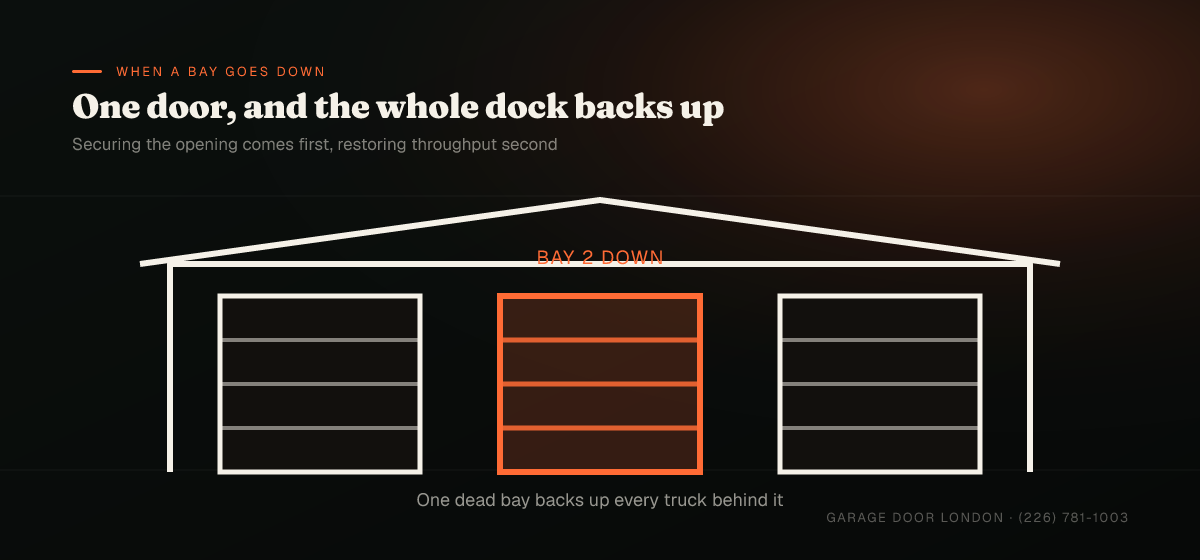
| Vehicle strike on a bay door | Structural damage, open building | Make safe, secure, order sections | Secure only |
| Fire door dropped on its release | Life-safety device out of service | Reset and test, or lock out | Usually yes |
The last row deserves a specific note. A fire-rated rolling door that has dropped on its fusible link or release mechanism is a life-safety device, not just a door. It needs resetting and drop-testing by someone competent to do it, and until that is done the opening it protects is not rated. If that is what has happened, say so when you call.
What is not an emergency: a noisy door, a worn seal, a dented panel that still operates, or a slow operator. Those are real problems and they should be booked — but at a scheduled rate, in daylight, without an after-hours premium. Our commercial service page covers scheduled work.
The commercial doors we service, and how each fails
Commercial doors are not just bigger residential ones. The construction, the hardware and the failure modes are genuinely different, and the parts are not interchangeable — which is why phone triage matters so much on a commercial call.
| Door type | Where you find it in London | Common emergency failure |
|---|---|---|
| Insulated sectional, high-cycle | Warehouses, distribution, service bays | Spring or cable failure at 20,000+ cycles |
| Rolling steel service door | Storefronts, self-storage, mechanical bays | Curtain jam, bent slats, barrel spring failure |
| Rolling steel fire door | Fire separations, industrial openings | Dropped on release, needs reset and drop test |
| Sectional dock door with leveller | Loading docks | Bottom section damage, seal and leveller interaction |
| High-speed roll-up (fabric) | Food processing, clean areas | Curtain tear, photocell fault, controller error |
| Aluminium full-view | Showrooms, restaurants, garages | Glass damage, hinge and stile wear |
| Grille / security shutter | Retail, parkade entries | Lock jam, curtain out of the guides |
Why high-cycle springs change the maths
A residential door runs perhaps 1,500 cycles a year. A busy dock bay can run 15,000 — ten years of household use in twelve months. That is why commercial springs are specified by cycle rating up front (typically 50,000 to 100,000) and why cycle counting matters far more than a calendar. If your springs are builder-grade parts fitted to a door that runs constantly, you are not on a maintenance schedule, you are on a countdown. Our spring systems guide explains cycle ratings, and warehouse garage door repair covers the industrial side in more depth.
The second thing that changes is manual operation. A homeowner can lift a residential door by hand in an emergency. Nobody is hand-lifting a 500 lb insulated dock door. Commercial doors rely on a chain hoist or a jackshaft operator with a manual release, and if staff have never been shown where it is, a solvable problem becomes a stopped shift.
What a dead bay actually costs per hour
Facility managers know this number instinctively; owner-operators often have not worked it out. It is worth doing, because it reframes both how fast you should call and how much preventative maintenance is worth.
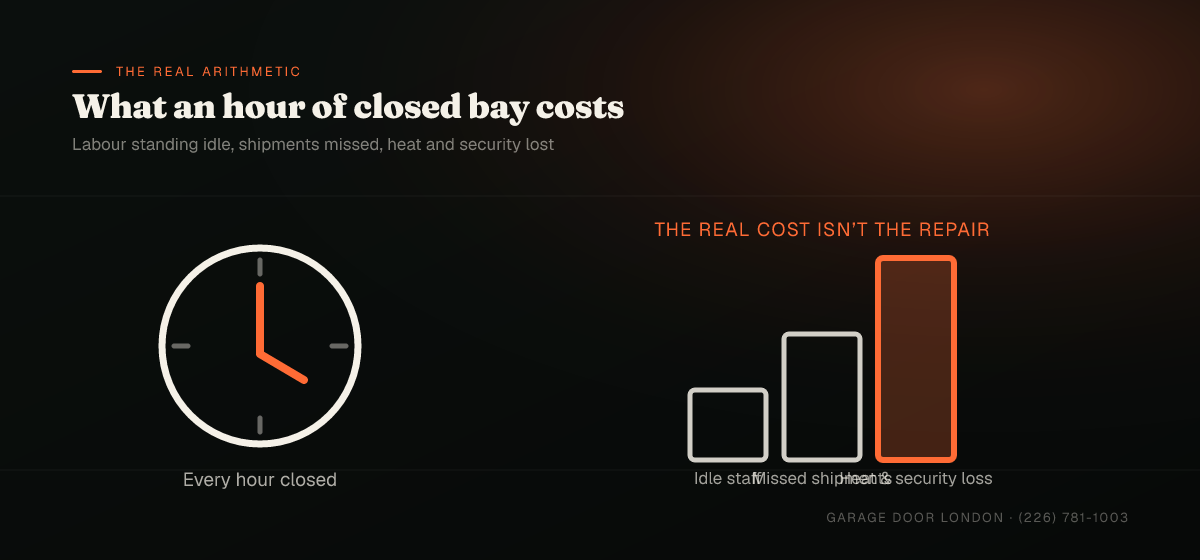
| Cost line | What drives it | Typical order of magnitude |
|---|---|---|
| Idle labour | Staff who cannot work the bay | Hourly rate × headcount × hours |
| Missed or delayed shipments | Carrier windows, penalty clauses | Often the largest single line |
| Heat or refrigeration loss | An open bay in a London winter | Significant on a cold night |
| Security exposure | Unsecured building overnight | Insurance conditions may require attendance |
| Overtime to recover | Catching up the backlog | 1.5× on the shift that follows |
| The repair itself | Parts and after-hours labour | $300 – $1,400 |
The repair is nearly always the smallest number on that list. Which leads to the practical conclusion: on a commercial door, calling immediately is almost always cheaper than waiting for business hours, and paying for a proper preventative maintenance contract is almost always cheaper than either.
The instinct on a busy dock is to get a forklift or three people onto a stuck door. On a rolling steel curtain or a high-cycle sectional, that turns a spring or cable failure into bent slats, a bent shaft, or a door off its guides — and it puts people directly under a suspended load. Lock the bay out, tape it off, and call. The wait is shorter than the extra repair.
How an emergency commercial call actually runs
Commercial dispatch differs from residential in one important way: the triage on the phone determines what goes on the truck, and getting it wrong means a second visit. Six questions do most of the work.
- What type of door? Sectional, rolling steel, fire-rated, high-speed fabric, or grille. This decides the parts entirely.
- Approximate size and whether it is insulated. Weight determines spring and cable specification.
- Is the door open, closed, or stuck partway? An open building is prioritised over a closed one.
- Is the building secure right now? If not, that changes the dispatch priority and what we bring to close the opening.
- What happened, and what was heard? A bang points at springs; a grinding stall points at the operator or the guides.
- Site access after hours. Gate codes, keyholder contact, and where the panel is. Half of commercial delays are access, not repair.
From there the sequence on site is consistent: make safe, secure the opening, quote, repair, test. Securing comes before repairing every time — if a full repair will take until morning because a section has to be ordered, the opening still gets closed and secured tonight.
| Job | Typical range | Notes |
|---|---|---|
| After-hours commercial service call | $150 – $250 | Rolled into the repair where work proceeds |
| High-cycle spring replacement | $400 – $900 | Per spring set, by cycle rating and door weight |
| Commercial cable and drum replacement | $350 – $700 | Always in pairs |
| Rolling steel curtain re-set in guides | $400 – $850 | More where slats are bent |
| Commercial operator repair | $300 – $800 | Logic board, contactor, limit switches |
| Jackshaft operator replacement | $900 – $2,200 | Installed, by horsepower and duty cycle |
| Secure an opening overnight | $200 – $450 | Where full repair needs ordered parts |
| Fire door reset and drop test | Quoted per door | Documented for your records |
Every commercial job ends with the same tests as a residential one plus the ones specific to the door type: balance and travel on sectionals, curtain tracking and guide clearance on rolling steel, photocell and reversing edge function on any powered door, and a documented drop test on fire-rated doors.
How to stop the next emergency before it happens
Nearly every commercial emergency we attend was visible in advance. Not predictable to the day — but visible. Four things reduce after-hours calls more than anything else.
1. Count cycles, not years
Fit or estimate a cycle count on every high-use bay and specify springs by rating. A 50,000-cycle spring on a bay running 15,000 cycles a year needs planning at year three, not year ten. This single change moves most spring failures from the emergency column into scheduled work.
2. Put maintenance on a schedule that matches the duty
Annual is a residential number. A busy dock bay wants quarterly; a moderate-use service bay twice a year. The visit covers the same fundamentals as a residential tune-up plus commercial specifics: guide clearance, curtain tracking, operator duty cycle, reversing edge and photocell function, and a documented safety inspection per door.
3. Train staff on the manual release — before they need it
Every person who works a bay should know where the chain hoist or manual release is, how to use it, and when not to. Ten minutes at an induction saves an hour of downtime later. It is also a safety matter: staff improvising on a suspended door is how people get hurt.
4. Keep a door register
- Door type, size, weight and manufacturer for every opening
- Spring cycle rating and the date last replaced
- Operator make, model and horsepower
- Any fire-rated doors and the date of the last drop test
- Who to call, and the after-hours access arrangement
Hand that list to a technician on the phone at 9 p.m. and the right parts get loaded first time. Without it, the first visit is often diagnostic and the repair happens on the second — which doubles the downtime for no good reason.
Garage Door London services commercial doors across the London region, including London proper, St. Thomas, Woodstock, Strathroy and the surrounding industrial areas. We are fully insured and answer the phone at any hour. See commercial garage door service, commercial installation, or arrange a maintenance contract.
Get a flat-rate price in minutes
Frequently asked questions
Yes. Garage Door London dispatches to commercial and industrial sites 24 hours a day, seven days a week across London and the surrounding area, including evenings, weekends and holidays. Typical response is 60 to 120 minutes depending on location and time of day.
Any failure that stops the business, leaves the building unsecured, or creates a hazard for staff. That includes a door stuck open at close of business, a dock door down mid-shift, a jammed rolling steel shutter, a broken spring on a high-cycle door, an operator failure on a door too heavy to move by hand, and a fire-rated door that has dropped on its release.
Most after-hours commercial repairs land between $300 and $1,400. The after-hours service call is $150 to $250 and is rolled into the repair where work proceeds. High-cycle spring replacement runs $400 to $900, commercial cable and drum work $350 to $700, and operator repair $300 to $800. A jackshaft operator replacement is $900 to $2,200 installed.
Yes, and that is the first objective on every call. Where a full repair needs an ordered part, we close and secure the opening the same night for $200 to $450, then return to complete the repair once the part arrives.
Yes. We service rolling steel service doors, security grilles and fire-rated rolling doors. A fire door that has dropped on its fusible link or release needs resetting and a documented drop test before the opening is rated again — tell us on the call if that is what has happened.
Match the interval to the duty, not the calendar. A busy loading dock running 10,000 or more cycles a year wants quarterly service; a moderate-use service bay twice a year. Annual maintenance is a residential interval and is not enough for high-cycle commercial doors.
Cycle volume. A residential door runs about 1,500 cycles a year while a busy dock bay can run 15,000 — ten years of household use in twelve months. Commercial springs are specified by cycle rating, typically 50,000 to 100,000, and should be planned against actual cycle count rather than age.
Door type (sectional, rolling steel, fire-rated, high-speed fabric or grille), approximate size and whether it is insulated, whether the door is open, closed or stuck partway, whether the building is currently secure, what was heard when it failed, and your after-hours site access including gate codes and keyholder contact.
No. Forcing a stuck rolling steel curtain or a high-cycle sectional turns a spring or cable failure into bent slats, a bent shaft, or a door out of its guides, and it puts people underneath a suspended load. Lock out the bay, tape it off, and call.
Yes. Contracts are priced per door based on door type and cycle volume, and include scheduled service, documented per-door safety inspection, priority emergency response and a service log. Call (226) 781-1003 to have a site walked and quoted.
What we put in writing
A fixed price before we start. The full price in writing after the diagnosis and before any work begins. Find something unexpected once the door is open and we stop and re-quote rather than adding it to your bill.
A written warranty. Lifetime on the parts we supply and five years on our labour, printed on the invoice rather than promised at the door.
A safety test before we leave. Balance, cables, drums, opener force and travel limits, and the auto-reverse tested against an obstruction — recorded on your invoice with the date.